

Calculate your FBR builder and developer tax for Tax Year 2025-26
instantly. Enter your project’s covered area, select your city
(Karachi, Lahore, Islamabad or other cities), and choose project
type (residential or commercial) — get your exact tax liability
in seconds. Based on Finance Act 2025 fixed tax rates.
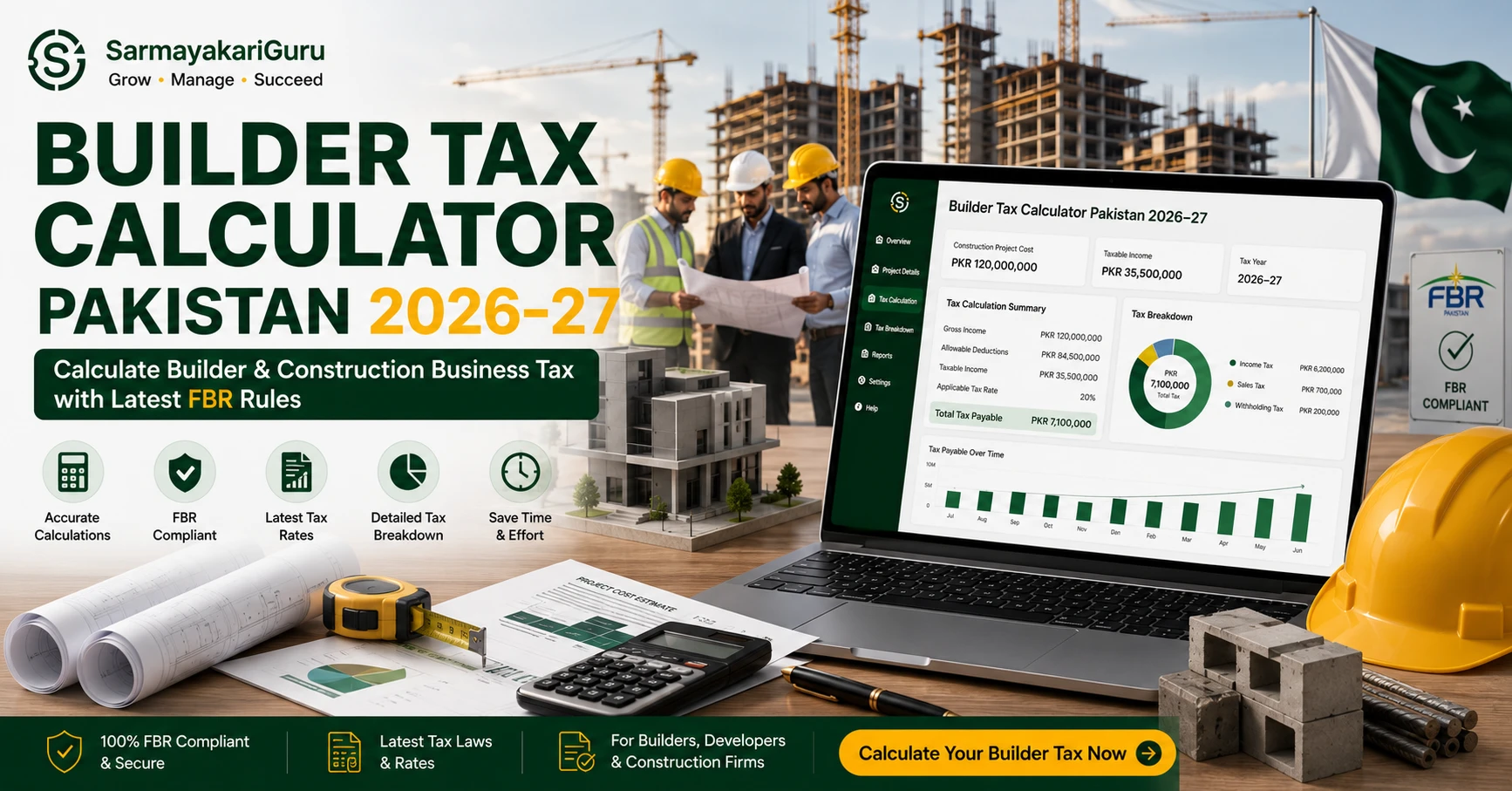
Calculate builder tax based on covered area and city-wise FBR rates for Tax Year 2026-27. This is the latest builder tax calculator as per the 2026-27 budget presented by the Government of Pakistan.
| Building Type | |
| City | |
| Area (Square Yards) | |
| Rate per Square Yard | |
| Annual Income Tax |
Under Section 7C of the Income Tax Ordinance 2001, builders and
developers in Pakistan are taxed under a special fixed tax regime —
meaning tax is charged on the covered area of your project per
square foot, not on your net profit. This makes builder tax
calculation straightforward once you know your city’s applicable
rate and your project’s total covered area.
For registered builders and developers under government schemes,
FBR calculates tax based on the total covered area of your project
in square feet — not your profit or loss. Each city has a
predefined rate per square foot for both residential and commercial
projects. This fixed tax is treated as a minimum and final tax on
that project’s income.
This means even if your project runs at a loss — perhaps due to
rising construction material costs — you still pay the fixed tax
on the covered area. And if your project is highly profitable,
your tax does not increase beyond the fixed rate. It is a
predictable system once you understand the rates.
For registered builders and developers under government schemes,
FBR calculates tax based on the total covered area of your project
in square feet — not your profit or loss. Each city has a
predefined rate per square foot for both residential and commercial
projects. This fixed tax is treated as a minimum and final tax on
that project’s income.
This means even if your project runs at a loss — perhaps due to
rising construction material costs — you still pay the fixed tax
on the covered area. And if your project is highly profitable,
your tax does not increase beyond the fixed rate. It is a
predictable system once you understand the rates.
If your project is not registered with FBR under the fixed
tax scheme, your builder income is treated as normal business
income and taxed on net profit:
Annual Net Profit Tax Rate
Up to Rs. 600,000 0%
Rs. 600K — Rs. 1.2M 15%
Rs. 1.2M — Rs. 2.4M 20%
Rs. 2.4M — Rs. 3M 25%
Rs. 3M — Rs. 4M 30%
Above Rs. 4M 35%
In most cases, registering with FBR and paying fixed tax
per square foot is more advantageous than being taxed on
net profit — especially for profitable projects.
→ Calculate your business income tax: [Free Business Tax Calculator](https://sarmayakariguru.com/business-tax-calculator-pakistan/)
Pro Tip: Register your construction project with FBR before you break ground — not after. Late registration or non-registration means losing the fixed tax benefit and being assessed on net profit instead. SarmayakariGuru's tax team handles complete FBR builder project registration, advance tax computation, and annual compliance — so you focus on building while we handle the tax side.
Sarmaya Kari Guru is strictly an educational platform. We do not provide personalized investment advice, brokerage services, or guarantee returns. Investing involves risk. Please consult with licensed financial professionals before making any financial commitments.
Builder tax in Pakistan is paid in two stages:
Advance Tax: Paid during the construction phase as the project
progresses. FBR requires advance tax payments at different
milestones of construction.
Final Tax: Paid at project completion. The total tax for the
project is calculated on the full covered area, with advance
tax payments deducted from the final liability.
This tax is treated as a final discharge of your tax liability
on that specific project — no separate income tax is charged
on the project profit if you are registered under the fixed
tax scheme.
To qualify for the fixed tax regime rates, builders must
register their project with FBR before construction begins.
Registration requires:
– Project name and location
– Total planned covered area (square feet)
– Estimated project cost
– Planned completion timeline
– Builder’s NTN number and details
Unregistered builders do not qualify for the predictable
fixed tax rates and are instead taxed under normal business
income tax slabs (0% to 35%) on net profit — which can
result in significantly higher and less predictable tax
liability.
Get results in milliseconds with our optimized calculation engine.
Privacy first. Calculate your tax without sharing any personal data.
Updated regularly to match the latest Finance Act changes.
Intuitive interface designed for business owners, not just accountants.
Focus on growing your core business while we handle the complexities of ERP, Accounting, and Taxation.
Your premium partner for digital transformation and financial excellence in the modern enterprise landscape.
© 2026 SarmayaKariGuru. A Project of RSGROUP. All rights reserved.