

Calculate your Agricultural tax instantly based on profit, expenses, and current FBR applicable tax rates for the fiscal year.
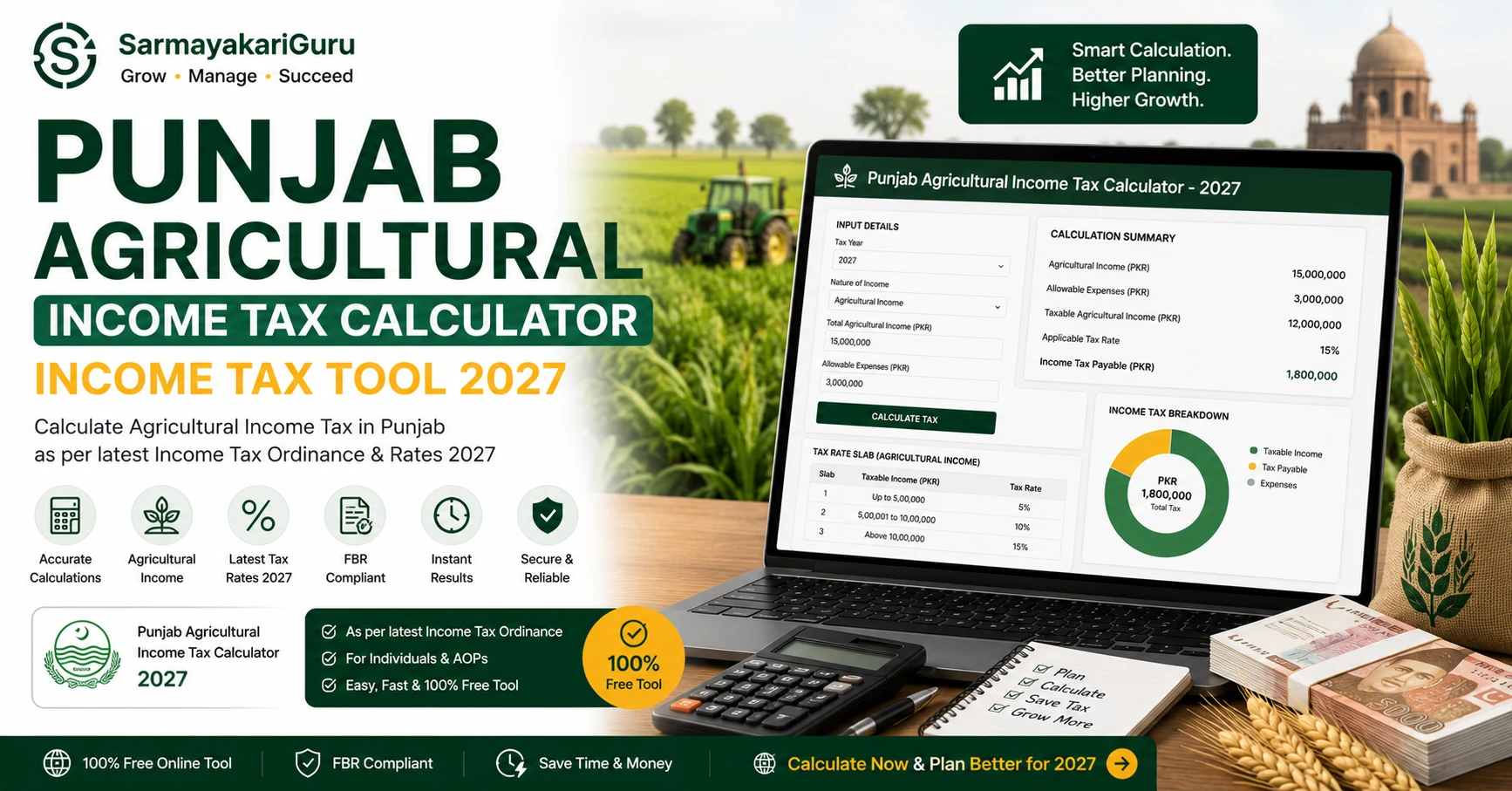
Calculate agricultural land tax for Punjab province based on official rates for Tax Year 2026-27. This is the latest calculator as per the 2026-27 budget presented by the Government of Punjab.
| Land Type | |
| Irrigation Type | |
| Land Area | |
| Rate per Acre | |
| Tax on Income |
Agricultural income is one of the most misunderstood areas of taxation in Pakistan. Many landowners assume farming income is completely tax-free — and while that’s true at the federal level, it isn’t the full picture. Agricultural income is taxed by provincial governments, not the FBR, and each province has its own thresholds, slabs, and rules. This guide breaks down exactly how agricultural tax is calculated across Pakistan so you know what you owe and why.
Partially. Under Section 41 of the Income Tax Ordinance, 2001, agricultural income is exempt from federal income tax. This means the FBR does not collect tax on income earned directly from cultivating land, orchards, or livestock.
However, under the Constitution of Pakistan, the power to tax agricultural income belongs to the provincial governments — Punjab, Sindh, Khyber Pakhtunkhwa, and Balochistan. Each province has its own Agricultural Income Tax Act, and collection is handled locally, typically by the District Collector under provincial land revenue laws rather than by the FBR.
So while you won’t see agricultural income on your federal tax return, you may still owe provincial agricultural tax depending on where your land is located and how much you earn from it.
Agricultural income tax has become central to Pakistan’s fiscal policy discussions because of the ongoing IMF Extended Fund Facility. The IMF has pushed for provinces to expand and formalize agricultural taxation as part of broader revenue-generation commitments, since salaried and corporate taxpayers have historically shouldered a disproportionate share of direct taxes compared to the agriculture sector.
In response, provinces — starting with Punjab in 2025 and followed by Sindh, KP, and Balochistan — introduced amended Agricultural Income Tax Acts that:
Regardless of province, agricultural tax calculation generally follows this process:
Pro Tip: Always keep digital records of your expenses. Without receipts, FBR may disallow certain deductions during an audit.
Real-time processing as you type.
Always updated with FBR 2024-25 laws.
Mathematical accuracy down to the rupee.
| Province | Governing Law | Individual Exemption Threshold | Collecting Authority |
|---|---|---|---|
| Punjab | Punjab Agricultural Income Tax Act, 1997 (as amended 2025) | Rs 600,000/year | District Collector / Punjab Board of Revenue |
| Sindh | Sindh Agricultural Income Tax Act, 2025 | Rs 600,000/year | Sindh Revenue Board |
| Khyber Pakhtunkhwa | KP Agricultural Income Tax laws | Rs 600,000/year | KP Revenue Authority |
| Balochistan | Balochistan agricultural tax rules | Rs 600,000/year | Provincial Revenue Authority |
Important: Provincial slabs and thresholds are amended periodically, and each province is currently in the process of aligning its rules following the 2025 reform wave. Always verify current rates with your provincial revenue authority or a tax advisor before filing, as figures can differ from year to year and province to province.
Let’s walk through a simplified example for an individual farmer with Rs 2,000,000 in annual agricultural income, taxed progressively above the Rs 600,000 exemption threshold:
This is exactly why a dedicated agricultural tax calculator is useful — manually tracking which portion of income falls into which slab, across different provincial rules, is easy to get wrong.
Agricultural businesses operating as companies are taxed differently from individual farmers:
Some provinces, notably Sindh under its 2025 Act, have introduced a super tax on agricultural income exceeding very high thresholds — currently framed around incomes above Rs 150 million annually. This mirrors the federal super tax concept applied to large corporate and individual incomes, and is aimed squarely at large landholders and agribusiness operations rather than small and mid-sized farmers.
Pro Tip: Always keep digital records of your expenses. Without receipts, FBR may disallow certain deductions during an audit.
Focus on growing your core business while we handle the complexities of ERP, Accounting, and Taxation.
Your premium partner for digital transformation and financial excellence in the modern enterprise landscape.
© 2026 SarmayaKariGuru. A Project of RSGROUP. All rights reserved.