

Calculate your FBR business income tax for Tax Year 2026-27
(July 2026 — June 2027) instantly. Covers sole proprietors,
AOPs, and business individuals — based on Finance Act 2026.
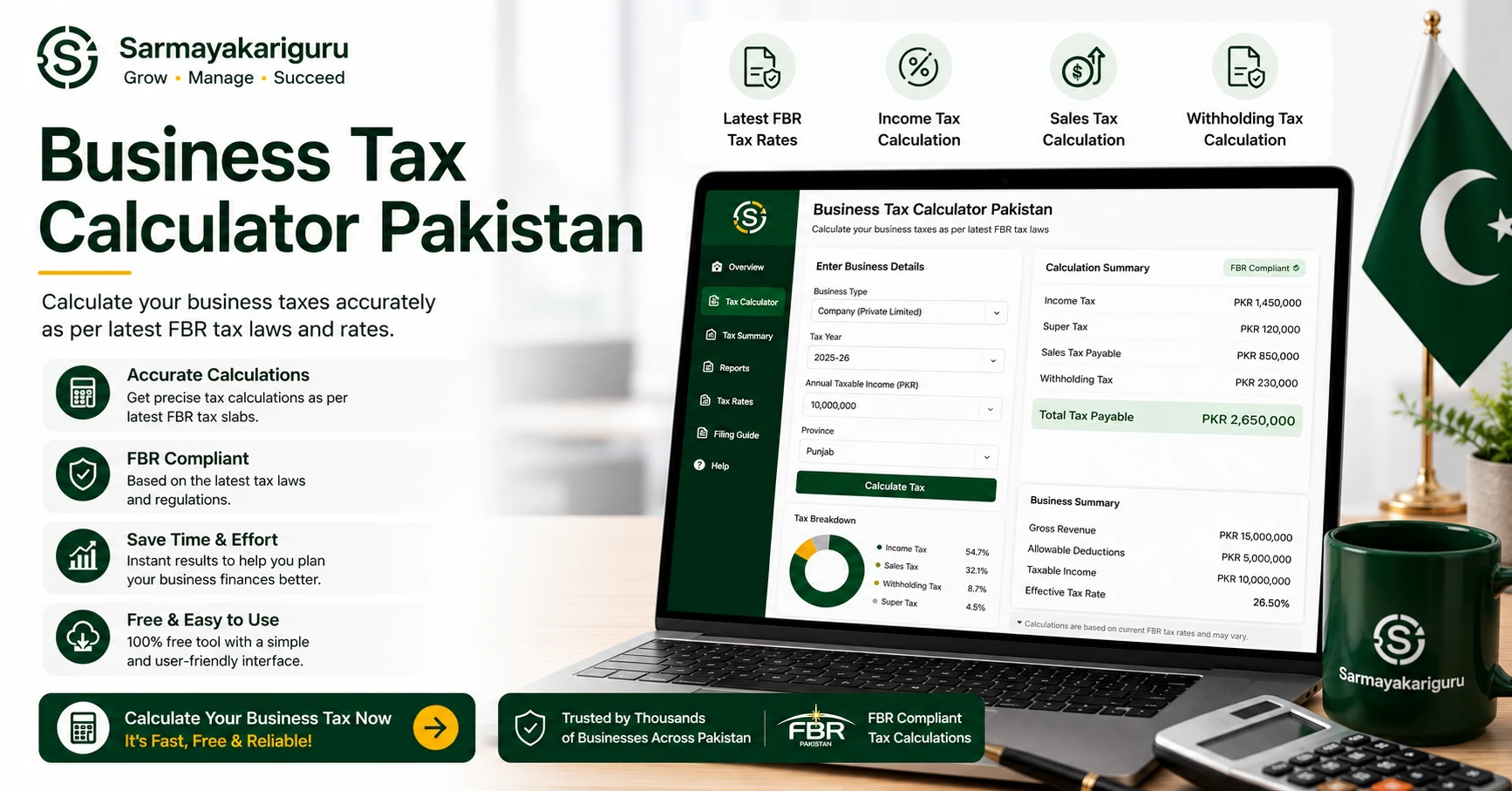
Calculate business income tax for AOPs (Association of Persons) and business individuals based on official FBR tax slabs for Tax Year 2026-27.
| Annual Business Income | |
| Tax on Income | |
| Effective Tax Rate | |
| Tax Slab Applied | |
| Income After Tax |
If you run a business in Pakistan — whether as a sole proprietor, part of an Association of Persons (AOP), or through a registered company — your income tax works very differently from a salaried employee’s. Business income is taxed on a separate, generally higher slab structure, and companies face their own flat corporate rates plus minimum tax rules. This guide breaks down exactly how business tax is calculated for Tax Year 2027 (FY 2026-27), so you can estimate your liability accurately before filing.
The FBR taxes business income differently depending on how the income is earned and by whom:
This distinction matters because business individuals and AOPs are taxed more heavily than salaried employees at equivalent income levels — a deliberate structural feature of Pakistan’s tax system, since salaried income is fully withheld at source while business income has historically been harder to document.
For individuals and AOPs whose income is not primarily salary (i.e., business owners, freelancers not under the final tax regime, and self-employed professionals), the following progressive slab structure applies:
| Taxable Business Income (PKR) | Tax Rate | Calculation |
|---|---|---|
| Up to 600,000 | 0% | No tax |
| 600,001 – 800,000 | 7.5% | 7.5% of amount exceeding 600,000 |
| 800,001 – 1,200,000 | 15% | 15% of amount exceeding 800,000 |
| 1,200,001 – 2,400,000 | 20% | 20% of amount exceeding 1,200,000 |
| 2,400,001 – 3,000,000 | 25% | 25% of amount exceeding 2,400,000 |
| 3,000,001 – 4,000,000 | 30% | 30% of amount exceeding 3,000,000 |
| Above 4,000,000 | 35% | 35% of amount exceeding 4,000,000 |
Important context: Budget 2026-27’s headline relief — the four reduced slabs and the abolished 9% surcharge — was specifically targeted at salaried individuals. Business and AOP slabs were not part of that relief package and continue to follow the structure above unless the final Finance Act 2026 states otherwise. Always verify against the latest FBR notification before filing, since business slabs are reviewed separately from salaried slabs each budget cycle.
Notice how much steeper this table is compared to the salaried slabs — a business owner earning Rs 2,400,000 annually pays meaningfully more tax than a salaried employee at the same income level, because the salaried slabs start their steepest rates much higher up the income scale.
Let’s calculate the tax for a sole proprietor with Rs 2,000,000 in annual taxable business income.
This progressive, bracket-by-bracket calculation is exactly what a business tax calculator automates — manually stacking each slab’s fixed and marginal components is where most calculation errors happen.
FBR allows deduction of genuine business expenses — salaries, rent, utilities, depreciation, and marketing costs. Always keep receipts and bank records. Undocumented expenses may be disallowed during an FBR audit — increasing your taxable profit and tax liability.
If your business is structured as a company (private limited or public limited), you don’t use the individual/AOP slabs above. Instead, flat corporate tax rates apply to your entire taxable profit:
| Company Type | Tax Rate |
|---|---|
| Small company (as defined under the Income Tax Ordinance) | 20% |
| Other companies (general corporate rate) | 29% |
| Banking companies | Higher rate, plus applicable super tax |
A “small company” generally must meet specific criteria around paid-up capital, turnover, and employee count as defined in the Income Tax Ordinance, 2001 — not simply be a small business by common definition. It’s worth confirming your company’s eligibility with a tax advisor, since misclassification can lead to underpayment notices.
Even if your business reports a loss or minimal profit, Pakistan’s minimum tax regime under Section 113 requires certain companies and individuals with turnover above a specified threshold to pay tax on gross turnover — generally 1.25% — if this exceeds the tax calculated on actual taxable income. This provision exists specifically to prevent businesses from minimizing tax liability through aggressive expense reporting.
Businesses and companies with very high income levels may also be subject to super tax, layered on top of standard corporate or individual business tax. Super tax applies progressively based on income slabs, with higher rates kicking in for income exceeding several hundred million rupees — this is aimed at large corporations and high-income individuals rather than small and medium businesses. If your business income is in this range, dedicated super tax calculation (separate from standard business tax) is essential.
Under Section 57 of the Income Tax Ordinance, unadjusted business losses can generally be carried forward for up to 6 years, reducing taxable income in future profitable years. This isn’t automatically factored into basic online calculators, so if your business has prior-year losses, it’s worth getting a proper computation done rather than relying on a simple slab calculator alone.
A common point of confusion is why two people earning the same annual income — one salaried, one self-employed — end up with very different tax bills. The answer lies in how each income type is documented:
The results generated by this calculator are estimates only — based on FBR income tax slabs for Tax Year 2026-27. Actual tax liability may vary depending on allowable deductions, tax credits, advance tax paid, and individual business circumstances.This tool is provided for general educational purposes by SarmayakariGuru — a project of RS Group. For accurate tax computation and FBR return filing, consult our certified tax consultants.
Get your complete business tax breakdown in milliseconds
— net profit, tax payable, and effective tax rate — updating
live as you enter your figures. No waiting, no page reload.
Your financial data stays private. No account creation,
no email required, no data stored. Calculate your FBR business
tax freely and anonymously as many times as needed.
Calculator is updated with Finance Act 2025 tax slabs
for Tax Year 2026 (July 2026 — June 2027). Sole proprietor,
AOP, and company tax rates all reflect current FBR law.
Simple, clean interface designed for Pakistani business
owners, traders, and freelancers — no accounting knowledge
required. Enter your net profit, get your tax instantly.
SarmayakariGuru — a project of RS Group — handles complete
FBR business income tax return filing for sole proprietors
and AOPs across Pakistan. Starting from Rs. 5,000.
September 30, 2026 deadline — don’t miss it.
Your premium partner for digital transformation and financial excellence in the modern enterprise landscape.
© 2026 SarmayaKariGuru. A Project of RSGROUP. All rights reserved.