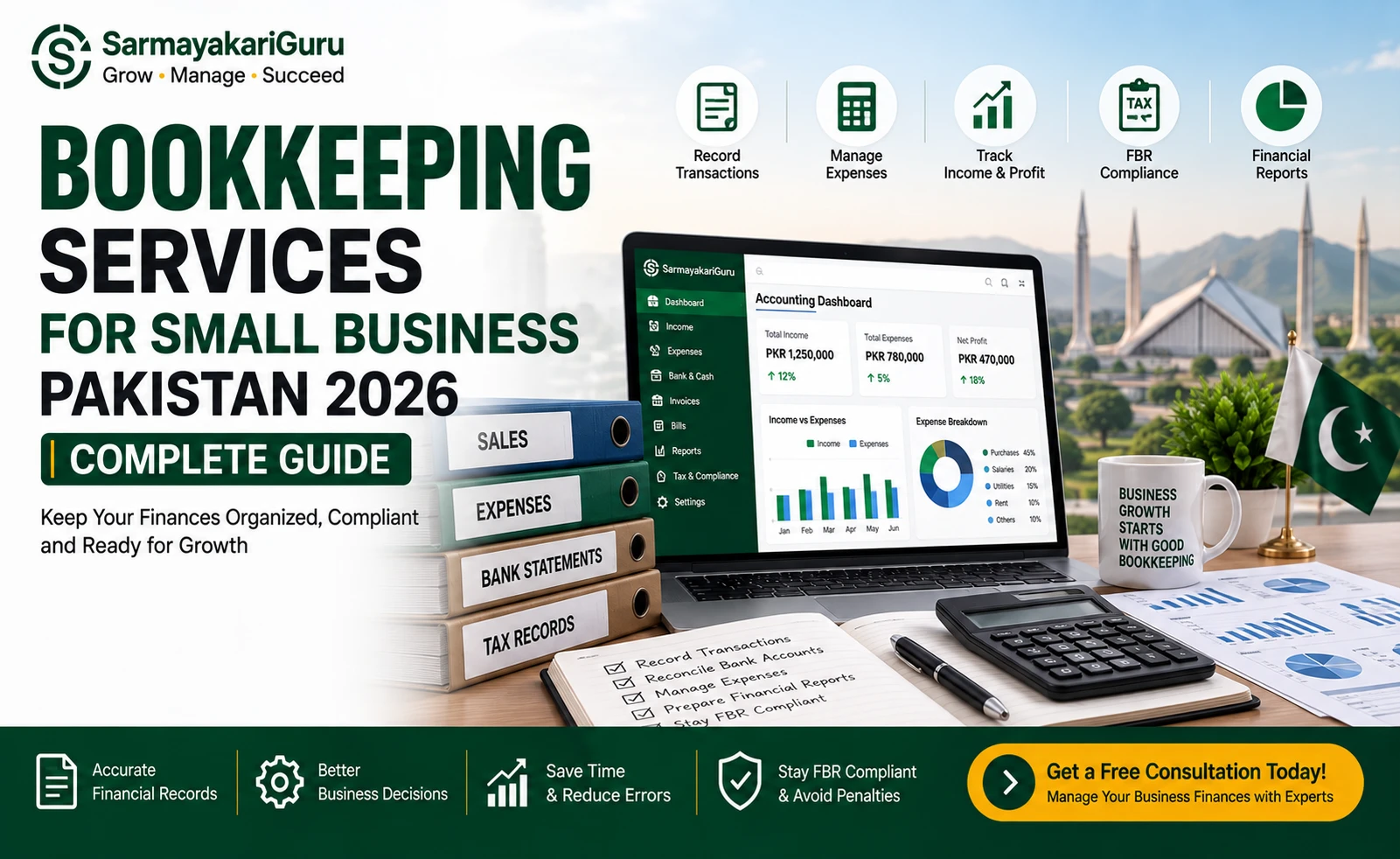


Most small business owners in Pakistan think about bookkeeping the same way they think about going to the dentist. They know they should do it properly. They keep putting it off. And then something painful happens — an FBR notice, a cash flow crisis, a loan application that gets rejected because the financials are a mess — and suddenly they wish they had taken it seriously from the start.
This guide is for Pakistani small business owners who want to understand what proper bookkeeping actually involves, why it matters far beyond just keeping FBR happy, what it costs to outsource it, and how to choose a service that genuinely fits your business.
What Is Bookkeeping and Why Does It Matter for Pakistani Small Businesses?
Bookkeeping is the systematic recording of every financial transaction your business makes — every rupee that comes in and every rupee that goes out. Sales invoices, purchase receipts, bank deposits, supplier payments, staff salaries, utility bills, loan repayments — all of it, recorded accurately and consistently.
Bookkeeping does not stop at recording transactions — it supports structured reporting: Income Statements showing revenues, expenses, and profits over time; Balance Sheets reflecting assets, liabilities, and equity; and Cash Flow Statements tracking liquidity and financial stability. These financial statements are crucial for securing loans, attracting investors, and maintaining credibility with tax authorities.
For Pakistani small businesses specifically, clean bookkeeping has three immediate practical benefits.
First, it makes your FBR tax compliance straightforward. When your books are properly maintained throughout the year, filing your monthly sales tax return and annual income tax return becomes a matter of generating reports from your records — not scrambling through receipts in September trying to reconstruct twelve months of transactions.
Second, it gives you actual visibility into your business. Without organized books, most Pakistani small business owners genuinely do not know if they are profitable — they confuse cash in the bank with profit, and confusion between the two has ended many businesses that appeared to be doing well on the surface.
Third, it protects you when FBR comes calling. In Pakistan, cash and digital payments often mix. Professional bookkeeping bridges this gap — recording every rupee clearly, including large vendor payments through banks and small petty cash for office supplies. When FBR requests your records during an audit, having organized books is the difference between a routine response and a prolonged, expensive dispute.
What Does Professional Bookkeeping Include for a Pakistani Small Business?
When you hire a professional bookkeeping service in Pakistan, here is what the work actually involves on an ongoing basis:
Recording daily transactions — every sale, every purchase, every bank deposit, every cash payment. In Pakistan where both cash and digital payments are common, a good bookkeeper tracks both without gaps.
Bank reconciliation — matching your bookkeeping records against your actual bank statements every month to catch errors, unrecorded transactions, and discrepancies before they become bigger problems.
Accounts receivable management — tracking which customers owe you money, how long their invoices have been outstanding, and flagging overdue payments for follow-up.
Accounts payable management — tracking what you owe your suppliers, ensuring payments are made on time, and maintaining good supplier relationships through clean payment records.
Payroll processing — calculating monthly salaries, EOBI contributions, PESSI deductions, and FBR salary tax withholding for all employees as per Pakistan Labour Law. Our SME ERP and accounting package handles payroll as part of the integrated service.
Monthly financial statements — profit and loss statement, balance sheet, and cash flow statement delivered every month so you actually know how your business is performing.
FBR-compliant record keeping — maintaining records in the format FBR requires, including proper invoice documentation and input tax records for sales tax purposes.
The Real Cost of Not Having Proper Bookkeeping
According to research, 82% of small businesses fail owing to a lack of understanding and management of cash flow — highlighting the need for competent bookkeeping.
This statistic resonates strongly in Pakistan, where the informal nature of many small businesses means that cash flow problems often go undetected until they become crises.
Here is what poor bookkeeping actually costs a typical Pakistani small business:
FBR penalties. Without clean records, your monthly sales tax returns are guesswork. Errors attract penalties — Rs. 10,000 per incorrect return is standard, and consistent errors trigger audit selection. The FBR official site publishes penalty structures for bookkeeping and filing violations.
Overpaid income tax. Without proper expense records, you cannot claim all your legitimate business deductions. Pakistani small business owners routinely overpay income tax because their bookkeeper cannot document expenses that were never properly recorded. Every undocumented business expense increases your taxable profit unnecessarily.
Lost input tax credit. For businesses registered for sales tax, input tax claims require proper purchase invoices from registered suppliers with valid STRNs. Without organized bookkeeping, these invoices get lost or are never recorded properly — meaning you pay more sales tax than you owe. You can verify supplier registration on iris.fbr.gov.pk.
Loan rejection. Banks in Pakistan require at least two years of audited or certified financial statements for business loans. If your books are not maintained, your loan application dies before it starts — regardless of how profitable your business actually is.
Investor problems. As your business grows and you look for investment or partnerships, every serious investor or partner will ask for financial statements. Disorganized books immediately raise questions about management quality and business fundamentals.
Bookkeeping vs Accounting — What Is the Difference?
This confusion comes up constantly in conversations with Pakistani small business owners, so let us clarify it once.
Bookkeeping is the day-to-day recording of financial transactions. It is operational — data entry and organization. A bookkeeper records what happened.
Accounting uses that organized data to analyze your business performance, prepare formal financial statements, handle tax filings, and provide financial advice. An accountant interprets what the bookkeeper recorded.
For a small business, you typically need both. The bookkeeper maintains your daily records. The accountant prepares your annual financial statements, files your tax returns, and advises on financial decisions.
Our accounting and taxation services combine both into one monthly package — so you get organized books and professional financial statements without managing two separate service providers.
How Much Do Bookkeeping Services Cost in Pakistan?
A full-time senior accountant in Karachi costs PKR 100,000 per month. Using outsourced bookkeeping services gives you expert work for much less.
For a Pakistani small business, the realistic cost options are:
In-house bookkeeper: Rs. 30,000 to Rs. 60,000 per month for a decent bookkeeper in a major city — plus EOBI, benefits, office space, and computer equipment. Total real cost typically Rs. 45,000 to Rs. 80,000 monthly.
Part-time visiting bookkeeper: Rs. 10,000 to Rs. 25,000 per month for someone who visits your office two to three times per week. Works for very low transaction volumes but creates dependency on one person who might leave.
Outsourced bookkeeping service: Rs. 8,000 to Rs. 25,000 per month depending on transaction volume and services included. All the expertise, none of the HR headaches.
SarmayakariGuru’s bookkeeping packages for Pakistani small businesses start from Rs. 8,000 per month — covering monthly transaction recording, bank reconciliation, and profit and loss statements. The Growth package at Rs. 15,000 per month adds cloud ERP access and FBR sales tax returns. Full details are on our SME solutions page.
Cloud Bookkeeping vs Traditional Methods — What Pakistani Businesses Should Use
The bookkeeping industry in Pakistan is seeing increasing demand for outsourced bookkeeping services, particularly among small and medium-sized enterprises looking to streamline their operations. New entrants are leveraging technology to offer innovative solutions.
Traditional bookkeeping in Pakistan — paper ledgers, Excel spreadsheets, a visiting part-time accountant — is increasingly inadequate for businesses trying to stay FBR-compliant and competitive.
Cloud-based bookkeeping gives you real-time access to your financial position from any device. Your sales are recorded as they happen. Your bank reconciliation is automated. Your monthly reports are generated at the click of a button. And your data is backed up securely — not sitting on a laptop that could be stolen or a hard drive that could fail.
For e-commerce businesses selling on Daraz or Shopify, cloud bookkeeping integrated with your sales channels automatically records every order, every COD payment, every platform commission — eliminating hours of manual work each month. Our e-commerce ERP handles this integration natively for Pakistani online sellers.
How to Choose a Bookkeeping Service for Your Small Business in Pakistan
Not all bookkeeping services in Pakistan are equal. Here is how to evaluate your options:
FBR knowledge is non-negotiable. Your bookkeeper must understand Pakistan’s tax system — sales tax, income tax withholding, the difference between federal and provincial sales tax, and FBR’s documentation requirements. A bookkeeper who does not know what an STRN is should not be managing your records.
Ask about their software. Good bookkeeping services in Pakistan use cloud-based accounting software that gives you real-time access to your own financial data. Be cautious of services that keep your books in files you cannot access without them — this creates unhealthy dependency.
Monthly reports as standard. Your bookkeeping service should deliver a profit and loss statement and basic balance sheet every month — not just once a year when your accountant files your taxes. If a service does not include monthly reporting, you are getting data storage, not bookkeeping.
Integration with tax filing. The best arrangement is when your bookkeeper and your tax accountant are the same team — or work closely together. This eliminates the gap between recorded transactions and filed returns that causes errors in FBR submissions.
Clear, transparent pricing. Get a complete breakdown of what is included in the monthly fee — transaction volume limits, which reports are included, whether FBR filing is extra, and what happens if your transaction volume grows.
Book a free consultation with SarmayakariGuru’s team — we assess your current bookkeeping situation honestly and recommend the right package for your business size and industry.
What Records Must Pakistani Small Businesses Maintain for FBR?
FBR requires businesses to maintain the following records for at least five years:
- Sales invoices issued to customers
- Purchase invoices received from suppliers
- Bank statements and deposit slips
- Payroll records and salary slips
- Stock registers (for businesses with inventory)
- Import and export documents (if applicable)
- Annual financial statements
Failing to maintain these records is itself a violation — separate from any tax underpayment — and can result in penalties during an FBR audit. Professional bookkeeping ensures all required records are maintained in the correct format and are readily available when needed. You can check FBR’s record-keeping requirements at fbr.gov.pk.