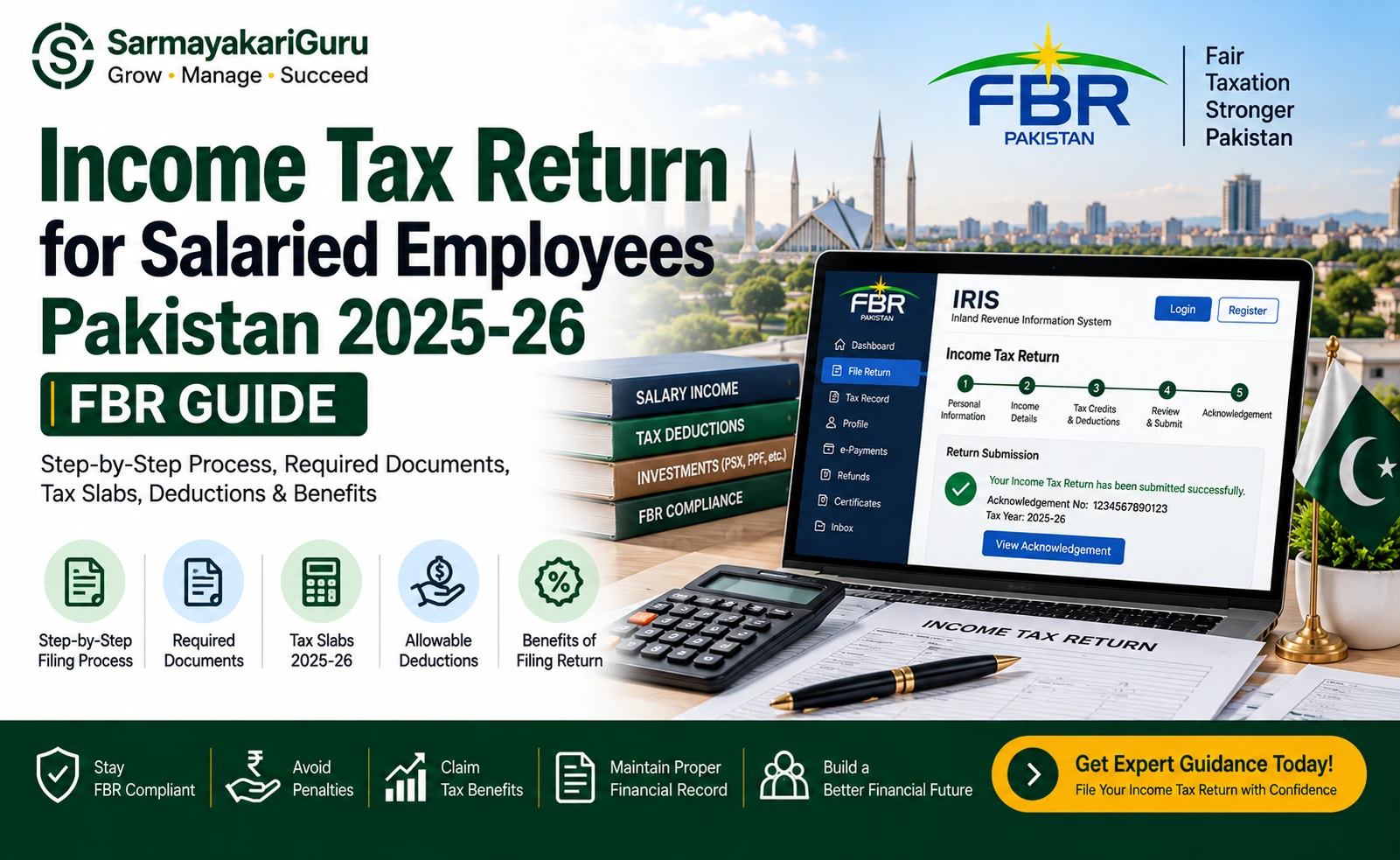

Here is something most salaried employees in Pakistan get wrong: if your employer deducts tax from your salary every month, you still need to file your own income tax return.
Your employer’s monthly deduction is an advance tax — an estimate. It may be too much or too little. The annual income tax return is how you settle the actual figure, claim refunds for overpaid tax, and maintain your status on the FBR Active Taxpayers List — which saves you money on every major financial transaction throughout the year.
This guide covers everything a salaried employee needs to know about filing for Tax Year 2025-26 — the slabs, deductions, step-by-step IRIS process, and how to legally reduce your bill.
Income Tax Slabs for Salaried Employees 2025-26
Pakistan uses a progressive tax system — you pay higher rates only on income above each threshold, not on your entire salary.
| Annual Taxable Salary | Tax Rate | Annual Tax |
|---|---|---|
| Up to Rs. 600,000 | 0% | Nil |
| Rs. 600,001 — Rs. 1,200,000 | 5% | Up to Rs. 30,000 |
| Rs. 1,200,001 — Rs. 2,200,000 | 15% | Up to Rs. 180,000 |
| Rs. 2,200,001 — Rs. 3,200,000 | 25% | Up to Rs. 430,000 |
| Rs. 3,200,001 — Rs. 4,100,000 | 30% | Up to Rs. 700,000 |
| Above Rs. 4,100,000 | 35% | Rs. 700,000+ |
Calculate your exact monthly deduction using our free salary tax calculator Pakistan 2025-26 — it gives instant results with monthly and annual breakdown.
What Counts as Taxable Salary?
Your full gross salary is not always fully taxable. FBR exempts certain components:
Medical allowance — up to 10% of basic salary is exempt if provided as genuine medical facility or reimbursement.
Conveyance allowance — partially exempt when used for official transport purposes.
Provident fund employer contribution — contributions to a recognized provident fund are generally exempt within prescribed limits.
Two employees earning the same gross salary can have different tax liabilities depending on how the salary is structured. If your employer has not reviewed your salary structure recently, it is worth discussing — restructuring legally exempt components reduces your monthly deduction without reducing take-home pay.
Who Must File Income Tax Return as Salaried Employee?
Filing is mandatory if your annual salary exceeds Rs. 600,000 — Rs. 50,000 per month. Even with employer tax deductions, your personal filing obligation exists separately.
Beyond legal obligation, filing gives you:
- Filer status on the ATL — lower withholding tax on all transactions
- Refunds if your employer deducted more than your actual liability
- Clean financial record for bank loans and visa applications
Check your current filer status at atl.fbr.gov.pk. If you are not showing as active, you are paying double withholding tax on bank withdrawals, property purchases, and vehicle registration right now.
Documents Needed Before Filing
- CNIC number
- Salary certificate or Form 16 from employer — showing annual salary and tax deducted
- Bank statements July 2025 to June 2026
- Bank profit certificates from all accounts
- Property details — address, area, year of purchase, cost price
- Vehicle details — registration and market value
- Investment details — PSX shares, mutual funds, National Savings
- Rental income details if any property was rented
The more organized your documents, the faster the filing process. Our tax filing services handle complete document collection and return preparation starting from Rs. 3,000.
Step-by-Step: Filing Income Tax Return on FBR IRIS
Step 1 — Register and Get NTN
Go to iris.fbr.gov.pk and click Registration. Enter your CNIC, date of birth, and mobile number. After OTP verification your NTN — typically your CNIC number — is generated instantly and for free.
Step 2 — Login and Start Return
Login with your CNIC and password. Click Declaration → Income Tax Return → Tax Year 2026 → Create. Select Salaried Individual as your taxpayer category.
Step 3 — Declare Salary Income (Section 149)
Under Income, select Salary and enter your employer’s name and NTN, total annual salary, and total tax deducted by your employer from your salary certificate.
Step 4 — Declare Other Income
Do not skip this even if salary is your main income:
- Bank profit (Section 151) — from bank certificates
- Rental income (Section 155) — gross annual rent received
- Dividend income (Section 150) — from shares or mutual funds
FBR cross-matches bank and property data with returns. Undeclared income from these sources is a common trigger for notices. Our guide on tax on rental income Pakistan covers rental declaration in detail.
Step 5 — Wealth Statement
Declare all assets and liabilities as of June 30, 2026:
- Property at cost price — not market value
- Vehicles at current market value
- Bank balances as of June 30
- Investments — shares, mutual funds, National Savings, prize bonds
- Cash in hand
- Liabilities — bank loans, mortgages
Your wealth increase must reconcile with your declared income. Large unexplained increases trigger FBR audit selection.
Step 6 — Claim All Tax Credits
This is where most salaried employees leave money on the table. Claim credits for:
- All tax deducted by your employer
- Withholding tax on bank transactions — from bank statements
- Bank profit tax — from bank certificates
- Utility bill WHT — if above Rs. 25,000/month
- Life insurance premium — within prescribed limits
- Tuition fee — 5% credit on children’s tuition at Pakistani institutions
- Charitable donations — up to 30% of taxable income to approved organizations
- Voluntary pension scheme contributions — up to 20% of taxable income
Claiming all eligible credits often results in a refund — your employer may have deducted more than your actual liability.
Step 7 — Submit
Click Verify, resolve any flagged errors, then Submit. Save your acknowledgment number. Your ATL status updates within 2 to 3 days on the next Sunday update at atl.fbr.gov.pk.
Filing Deadline — September 30, 2026
Tax Year 2025-26 return deadline is September 30, 2026 for all salaried employees, business persons, and AOPs.
Late filing penalty: Rs. 1,000 per day — maximum Rs. 50,000 — plus ATL removal. The combined cost of penalties and higher withholding tax from ATL removal almost always exceeds the cost of filing on time.
Start gathering documents in August. Do not leave it to the last week of September.
How to Legally Reduce Your Salary Tax
Voluntary Pension Scheme (VPS): Contributions to FBR-approved pension funds give a tax credit equal to your marginal rate on the contributed amount — up to 20% of taxable income. A Rs. 200,000 contribution at the 15% bracket saves Rs. 30,000 in tax.
Life insurance premium: Reduces your taxable income within prescribed limits.
Charitable donations: Up to 30% of taxable income donated to approved charities gives a 30% tax credit — saving Rs. 30,000 on a Rs. 100,000 donation.
Salary restructuring: Ask HR to review exempt components — medical allowance, conveyance allowance, and provident fund contributions within FBR limits reduce taxable salary without reducing gross package.
For personalized tax planning based on your specific salary and financial situation, our accounting and taxation services cover individual tax planning as part of our standard filing package.
Should You File Yourself or Hire a Consultant?
For a straightforward salary with no other income, filing yourself on IRIS is manageable and takes two to three hours with organized documents.
For salaried employees with additional income — rental income, PSX investments, freelance work, or foreign remittances — professional help ensures all income is correctly declared, all credits claimed, and your wealth statement reconciles properly.
SarmayakariGuru handles individual salaried tax returns from Rs. 3,000 including wealth statement and IRIS submission. Book a free consultation to discuss your situation.