
Your accountant is spending three days every month doing work that should take three hours. Your inventory numbers never match your accounting records. Your FBR sales tax return requires collecting data from three different places. And every time someone asks you a simple question — “how much profit did we make last month?” — the answer involves a phone call to your accountant and a two-day wait.
This is not a people problem. It is a systems problem. And the solution is Accounting ERP software — a system that connects your accounting with your inventory, your sales, your HR, and your FBR compliance so that everything talks to everything else automatically.
Pakistan’s market for Accounting ERP software has matured significantly. There are now genuine local options built for Pakistan’s tax laws and business realities, alongside international systems that require expensive customization before they can handle a basic FBR invoice. This guide helps you understand the difference and choose right.
What Is Accounting ERP Software and Why Does Pakistan Need It?
Accounting ERP software combines enterprise resource planning — managing your operations — with full accounting functionality in a single integrated system. The key word is integrated. When a sale happens in your POS, the revenue automatically posts to your accounting ledger. When you receive stock from a supplier, accounts payable automatically updates. When payroll runs, salary expenses automatically post to your profit and loss account.
This is fundamentally different from using separate accounting software alongside separate inventory software. With separate systems, someone has to manually enter data from one into the other — creating errors, delays, and the kind of reconciliation nightmares that keep accountants up at night.
For Pakistani businesses specifically, integrated Accounting ERP software solves a problem that standalone accounting tools cannot — FBR compliance that happens automatically as part of normal business operations rather than as a separate, manual exercise every month. When your ERP is properly configured for Pakistan’s tax laws, every invoice you issue is FBR-compliant, your sales tax is calculated correctly for PRA, SRB, KPRA, or BRA depending on your province, and your monthly return data is ready to file on the 18th without scrambling.
You can read about FBR’s digital compliance requirements directly at the Federal Board of Revenue’s official website at fbr.gov.pk — the direction of travel is clearly towards mandatory digital integration for more business categories every year.
What Pakistani Businesses Need from Accounting ERP Software
Before comparing any specific software, it is worth being clear about what matters for Pakistani businesses that often gets ignored in international comparisons.
FBR tax compliance must be built in from day one, not added as an afterthought. Your ERP must handle 17% GST on goods, provincial service tax variations across PRA, SRB, KPRA, and BRA, withholding tax deductions under multiple sections, and generate FBR-compliant invoices automatically. If a vendor says they will customize the tax module for you, add at least three months and significant cost to your budget estimate.
EOBI and Pakistan Labour Law payroll is another non-negotiable. Your HR module must calculate EOBI contributions, PESSI deductions, and income tax withholding on salaries using the correct FBR salary tax slabs for 2025-26. An international payroll module that knows nothing about Pakistan’s labour law is not a starting point — it is a liability.
Offline functionality matters in Pakistan more than most ERP vendors acknowledge. Power outages and internet disruptions are business realities across the country. Your Accounting ERP must keep working during these disruptions and sync automatically when connectivity returns. A retail business that cannot process sales during load shedding is losing revenue every time the power goes out.
Local support is the difference between a minor inconvenience and a crisis. When your system has an issue during a critical period — end of month, before an FBR deadline — you need someone who answers in Pakistan, understands your context, and can resolve the problem quickly.
Pricing in Pakistani rupees with no hidden USD exposure is increasingly important as the exchange rate fluctuates. International ERP systems priced in dollars can see their effective PKR cost change dramatically from one year to the next.
The Best Accounting ERP Software Options in Pakistan 2026
SarmayakariGuru ERP — Best for SMEs Wanting Accounting + Tax + Operations
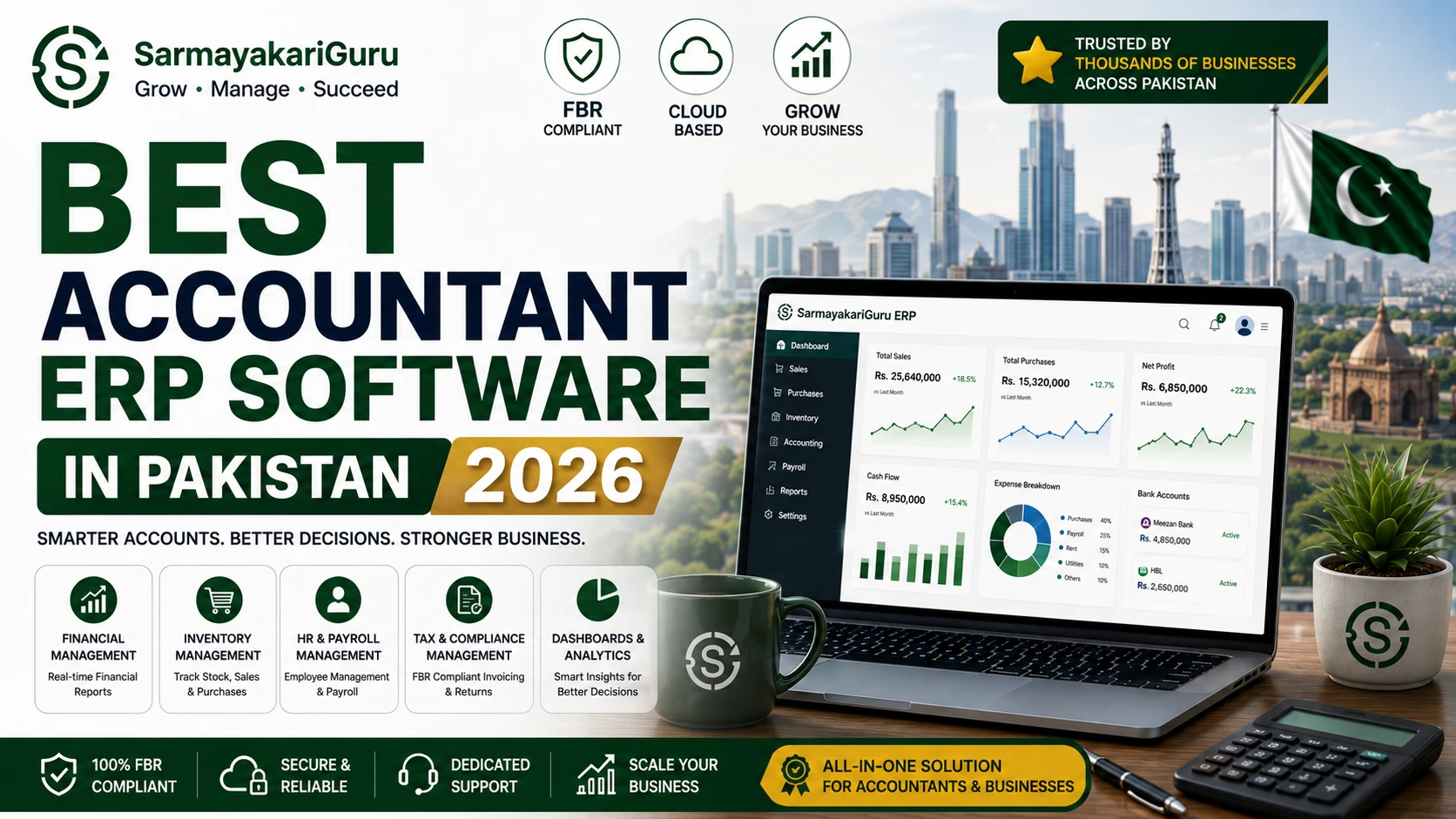
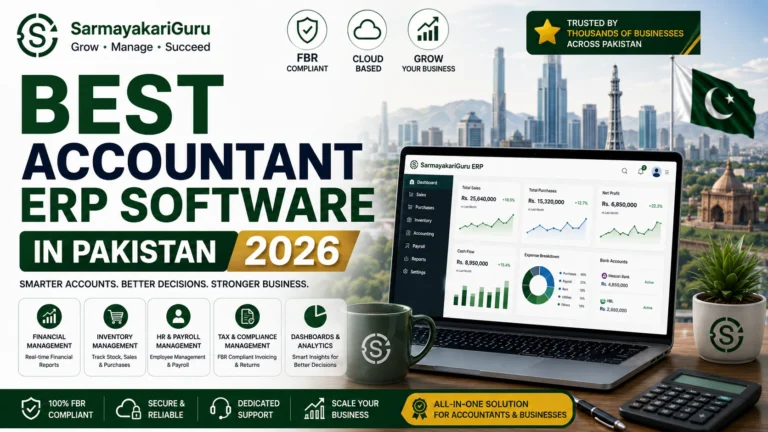
SarmayakariGuru ERP is a cloud-based Accounting ERP built specifically for Pakistan’s business and tax environment. What distinguishes it from other options in the market is the combination of complete ERP functionality with professional accounting and FBR tax filing services bundled into one relationship.
The accounting module handles double-entry bookkeeping, general ledger management, accounts receivable and payable, bank reconciliation, and complete financial statement generation — profit and loss, balance sheet, and cash flow statement. All of this connects directly to inventory, sales, purchasing, and HR so that every business transaction automatically creates the correct accounting entries without manual posting.
FBR compliance is pre-configured. GST at 17%, provincial service tax variations, withholding tax under Sections 149, 153, 155, and 156, and FBR-compliant invoice formatting are all handled automatically from day one. Your monthly sales tax return data is generated directly from the system — no manual reconciliation needed. If you want to understand your FBR filing obligations, our detailed guide on how to file sales tax return in Pakistan covers the complete process at sarmayakariguru.com/how-to-file-sales-tax-return-pakistan-2025-26/.
What genuinely sets SarmayakariGuru apart from pure software vendors is that the same team also provides professional bookkeeping and FBR tax filing services. If you want the software and want someone to run the accounting for you, that is available as a combined package. If you have your own Accounting who just needs the right tools, that works too. The flexibility matters for Pakistani SMEs at different stages of growth.
Retail businesses get POS integration with FBR receipt generation, multi-branch inventory, and customer loyalty management — all feeding into the same accounting system. You can explore the complete retail ERP functionality at sarmayakariguru.com/retail-erp-software-pakistan/.
Manufacturing businesses get bill of materials management, production planning, raw material tracking, and cost-per-batch analysis alongside the full accounting suite. The manufacturing ERP details are at sarmayakariguru.com/manufacturing-erp-software-pakistan/.
For e-commerce businesses on Daraz, Shopify, or WooCommerce, native platform integration means orders, COD payments from TCS and Leopards, and platform commissions automatically flow into your accounting records. No manual entry, no reconciliation headaches. See the e-commerce ERP at sarmayakariguru.com/e-commerce-erp-pakistan/.
Pricing starts from Rs. 25,000 one-time setup with monthly fees from Rs. 15,000 — all in PKR with no foreign exchange exposure. Book a free 30-minute demo at sarmayakariguru.com/contact-us-2/ to see the accounting module configured for your specific business type.
TallyPrime — Established Accounting with ERP Features
TallyPrime is one of the most widely used accounting software solutions in Pakistan and South Asia. Its core accounting functionality is solid — double-entry bookkeeping, financial statements, and inventory management are all mature and well-tested.
For Pakistani businesses, TallyPrime has local customizations available that address FBR and provincial tax requirements. The software has been in Pakistan long enough that a significant ecosystem of local support providers and implementers exists.
The limitations are primarily around integration breadth and cloud functionality. TallyPrime’s cloud capabilities are more limited compared to newer cloud-native systems. Its HR and payroll module for Pakistan Labour Law compliance requires additional setup. And for e-commerce integration with Daraz or Shopify, you are looking at custom development rather than out-of-the-box connectivity.
For a traditional business that needs solid accounting and basic inventory without complex e-commerce or manufacturing requirements, TallyPrime remains a reasonable option in Pakistan. Pricing is available from local resellers in PKR.
GENTEC ERP — Strong for Large Pakistani Manufacturers
GENTEC is an established Pakistani ERP vendor with substantial implementation experience particularly in manufacturing. Their accounting module connects to production, inventory, and purchasing in the way you would expect from a mature ERP system.
For medium to large manufacturers — textile mills, food processing companies, pharmaceutical manufacturers — GENTEC’s depth in production management combined with accounting integration makes it worth evaluating. Their local presence and support infrastructure is a genuine strength.
For smaller businesses and retailers, GENTEC’s pricing and implementation complexity may exceed what is actually needed. Their interface, while functional, lacks the modern cloud-native feel of newer systems. And their e-commerce integrations with Pakistani platforms like Daraz are limited compared to systems built with online commerce in mind.
Odoo — Flexible but Requires Technical Expertise
Odoo is an open-source ERP with a genuinely modern interface and extensive module library. For a Pakistani business with technical resources — an in-house developer or a technical co-founder — Odoo’s flexibility is genuinely valuable.
The accounting module in Odoo is comprehensive. Financial statements, bank reconciliation, multi-currency handling, and purchase-to-pay automation are all well-implemented. The challenge for Pakistan is the same as it is for most international systems — FBR compliance requires custom development, EOBI payroll requires custom configuration, and provincial tax variations are not standard.
If your business has the technical capacity to configure and maintain Odoo, it can be made to work well for Pakistan. If you need something that works out of the box for FBR compliance, the customization path adds significant time and cost.
QuickBooks — Accounting Only, Not ERP
QuickBooks appears in conversations about Accounting ERP software in Pakistan regularly enough that it deserves a clear, direct assessment.
QuickBooks is accounting software. It handles financial recording, invoicing, basic inventory tracking, and financial reporting well. What it does not have is the operational integration that defines ERP — no manufacturing module, no proper HR and payroll for Pakistan Labour Law, no Daraz or Shopify integration, and no FBR compliance built for Pakistan’s specific tax structure.
Use QuickBooks if you need basic accounting and your business has no physical inventory complexity, no manufacturing, and no multi-channel e-commerce. Graduate to proper Accounting ERP when those needs emerge — and for most Pakistani businesses, they emerge sooner than expected.
The Comparison Every Pakistani Business Owner Actually Needs
| Feature | SarmayakariGuru ERP | TallyPrime | GENTEC | Odoo | QuickBooks |
|---|---|---|---|---|---|
| FBR compliance built-in | Yes | Partial | Yes | Custom needed | No |
| Provincial tax (PRA/SRB/KPRA/BRA) | Yes | Partial | Yes | Custom needed | No |
| Pakistan payroll + EOBI | Yes | Setup needed | Yes | Custom needed | No |
| Cloud native | Yes | Partial | Yes | Yes | Yes |
| Offline mode (load shedding) | Yes | Yes | Partial | Partial | No |
| Daraz/Shopify integration | Yes | No | No | Custom | No |
| Urdu interface | Yes | No | Partial | No | No |
| Starting price (PKR/month) | Rs. 15,000 | Rs. 5,000+ | Rs. 20,000+ | Free-Rs. 20,000+ | Rs. 2,000+ |
| Local Pakistan support | Yes | Yes (resellers) | Yes | Limited | No |
| Accounting bundled with services | Yes | No | No | No | No |
Five Questions to Ask Any Accounting ERP Vendor Before Signing
The quality of ERP vendors in Pakistan varies significantly. These five questions reveal more than any brochure.
Ask them to demonstrate FBR invoice generation live during the demo — not describe it, show it. An invoice generating with correct NTN, STRN, GST calculation, and the right format tells you the compliance work has actually been done.
Ask what happens to your accounting data if you stop using their software. You should be able to export your complete chart of accounts, transaction history, and financial statements in a standard format. Vendor lock-in with your own financial data is a real risk.
Ask for the name and direct number of the person who will support you after go-live — not the sales team’s number. The quality of post-sale support determines whether your ERP implementation succeeds or becomes an expensive regret.
Ask whether the system handles reconciliation between your sales tax returns and your income tax return — because FBR cross-references both. A proper Accounting ERP should make this reconciliation straightforward.
Ask to speak with two current customers in your industry before signing. References from real Pakistani businesses in your sector are worth more than any demo.
How to Get Started with Accounting ERP Software
The practical starting point for most Pakistani businesses is a demo using your actual products, your tax setup, and your business scenario — not a generic walkthrough.
SarmayakariGuru offers a free 30-minute consultation at sarmayakariguru.com/contact-us-2/ where our team assesses your current systems, identifies the gaps, and demonstrates how the ERP handles your specific accounting and compliance needs. There is no commitment involved — just an honest assessment of whether our system is the right fit for your business.
For businesses that want to understand the accounting and taxation services that can run alongside the ERP, the complete service details are at sarmayakariguru.com/accounting-and-taxation-services-in-pakistan/. For small businesses evaluating whether ERP makes financial sense at their current size, the SME-specific packages are at sarmayakariguru.com/erp-for-small-business/.