
If you sell on Daraz, you already know the daily grind.
Orders come in overnight. You wake up and manually update inventory on Seller Center. A customer calls asking about a return you did not know was processed. Your TCS remittance arrives but you cannot figure out which orders it covers. At month end, your accountant asks for your Daraz sales figures and you spend two days cross-referencing Seller Center exports with your spreadsheet to get a number that still does not quite reconcile.
This is not a Daraz problem. It is a systems problem. And it is exactly what ERP for Daraz sellers in Pakistan solves.
What Does ERP for Daraz Sellers Actually Do?
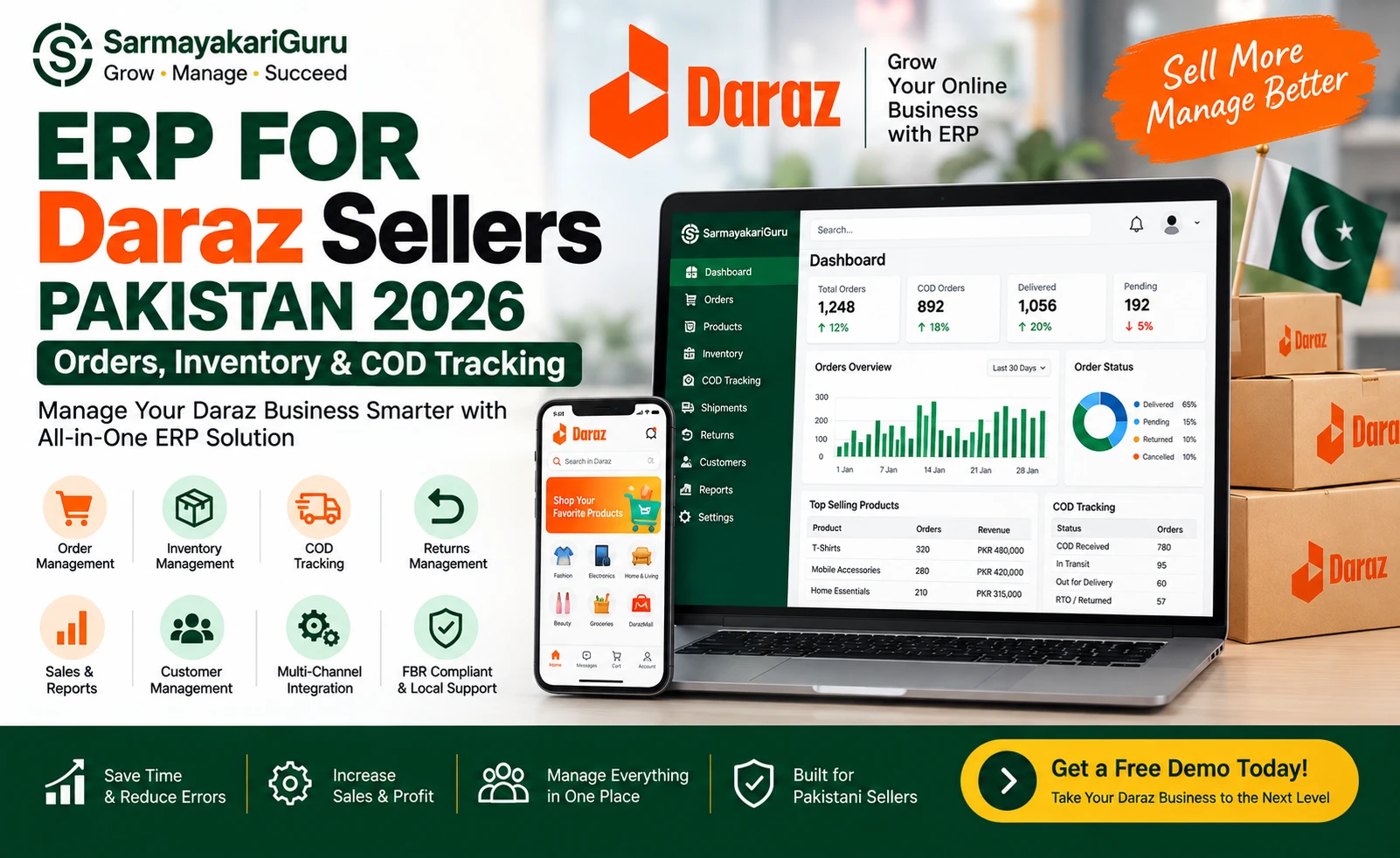
At its core, an ERP for Daraz sellers in Pakistan connects your Daraz Seller Center with your inventory, accounting, and FBR compliance in one automated system. Instead of manually updating stock, reconciling COD payments, and calculating tax from separate sources — the ERP handles all of it automatically as orders flow through.
When a Daraz order is placed, your ERP pulls it automatically — no manual import. When the order ships, your inventory reduces without you touching anything. When Daraz processes a return, your stock increases and your accounts reflect the reversal. When TCS or Leopards remits your COD payment, the ERP matches it against your orders and reconciles the difference. And throughout all of this, your accounting records are updating in real time so your month-end close takes hours instead of days.
For Daraz sellers who also sell on Shopify, WooCommerce, Instagram, or WhatsApp — the ERP consolidates all channels into one dashboard. One view of total orders, total inventory, and total revenue across every platform you sell on. Our e-commerce ERP covers the complete multi-channel integration available for Pakistani online sellers.
The Five Biggest Problems ERP Solves for Pakistani Daraz Sellers
Overselling due to inventory sync delays. Every Daraz seller has experienced this — selling a product on Daraz that sold out two hours ago on another channel because inventory did not update fast enough. ERP with real-time inventory sync eliminates overselling by updating stock across all channels the moment any sale is recorded, anywhere.
COD reconciliation nightmare. Pakistan runs on COD. TCS, Leopards, Trax, M&P, and Swyft all remit COD payments on different schedules in different formats. Without ERP, matching these remittances to specific orders is a manual exercise that takes hours every week. Our e-commerce ERP automatically imports courier remittance sheets and matches every payment to its order — giving you instant visibility on what has been paid, what is pending, and what has discrepancies.
Daraz commission reconciliation. Daraz deducts commissions, shipping charges, and other fees before remitting payment to sellers. Without ERP, calculating your actual net revenue — after Daraz deductions — requires manually analyzing Seller Center reports. ERP does this automatically and posts the correct net revenue to your accounting records.
FBR income tax on Daraz income. Every Pakistani Daraz seller earning above the taxable threshold must file an annual income tax return with FBR. Daraz also deducts withholding tax from your payments — and this deduction must be claimed as advance tax credit when you file your return. Without organized records, many Daraz sellers overpay their income tax by failing to claim these credits. ERP maintains clean records that make your income tax return filing accurate and your credits correctly claimed.
Profit visibility per product. Most Daraz sellers know their gross revenue — they can see it in Seller Center. But very few know their actual net profit per product after deducting product cost, packaging, Daraz commission, shipping, returns, and FBR tax. ERP tracks all of these costs and gives you real profit margins by product, by category, and by time period — so you know which products are actually making you money.
Key ERP Features Every Daraz Seller in Pakistan Needs
Native Daraz Seller Center integration is the foundation. Your ERP must connect directly to Daraz’s API — pulling orders automatically, updating inventory in real time, and syncing product listings between your ERP and Seller Center. Any ERP that requires manual export from Daraz and import to ERP is not genuinely integrated — it is just a slightly more automated spreadsheet.
Multi-courier COD tracking covers TCS, Leopards, Trax, M&P, Swyft, and any other courier you use. Remittance sheets from each courier are automatically imported and matched against your open orders. Your dashboard shows exactly which orders have been paid, which are in transit, which have been returned undelivered, and which have remittance discrepancies requiring follow-up.
Return management tracks returned products from the moment Daraz logs the return to when the product arrives back at your warehouse. Your inventory is updated automatically, your accounts reflect the reversal, and your return rate by product is tracked — so you can identify high-return products and investigate whether the issue is product quality, listing accuracy, or packaging.
Real-time inventory management across all your storage locations — whether you use a single warehouse, Daraz’s fulfillment center, or multiple storage locations across different cities. Low-stock alerts trigger before you run out, not after. Automatic reorder calculations factor in your average daily sales velocity so you always have the right amount of stock on hand.
FBR-compliant accounting posts every Daraz transaction — sales, commissions, returns, courier charges — to your accounting ledger automatically. Your monthly and annual financial statements reflect your actual Daraz business performance. When your accountant prepares your FBR return, the data is clean, organized, and reconciled. Check your current ATL status at atl.fbr.gov.pk — if you are not a filer, Daraz’s withholding tax deductions cannot be claimed as credits until you are.
Profit and loss per product is the feature that genuinely changes how Daraz sellers make decisions. When you can see that your best-selling product by volume is actually your worst-performing product by net margin — because of high return rates and Daraz commission — you make fundamentally different sourcing, pricing, and marketing decisions.
ERP for Daraz Sellers vs Managing Manually — What Changes
To make this concrete, here is what a typical day looks like for a Daraz seller managing manually versus with ERP.
Without ERP, a seller processing 50 orders per day typically spends 2 to 3 hours daily on manual order processing, inventory updates, and customer queries about order status. Month-end reconciliation takes 2 to 3 days. COD reconciliation is a weekly exercise that never quite balances. Profit is guessed rather than calculated.
With ERP, the same 50 daily orders process automatically. Inventory updates without manual intervention. COD reconciliation happens automatically when courier remittances are imported. Month-end close takes 2 to 3 hours instead of days. And profit is visible in real time from any device.
For Daraz sellers who have grown beyond 30 to 50 daily orders and are finding manual management increasingly unworkable — ERP is not a luxury. It is the operational infrastructure that allows further growth. Without it, every additional order adds proportionally more manual work. With it, you can scale from 50 to 500 daily orders without proportionally scaling your administrative team.
ERP for Daraz + Other Channels
Most Pakistani sellers who started on Daraz have diversified — adding their own Shopify or WooCommerce store, selling via Instagram and WhatsApp, or listing on multiple marketplaces simultaneously.
Managing inventory across multiple channels manually is where most growing Pakistani e-commerce businesses start breaking down. An item that sells on Daraz needs to reduce inventory on Shopify instantly — not when someone remembers to update it. A WhatsApp order needs to be recorded against the same inventory pool as your Daraz and Shopify sales.
Our e-commerce ERP for Pakistani online sellers connects Daraz, Shopify, WooCommerce, and TikTok Shop in one unified inventory pool — with all sales posting to the same accounting system automatically. If you have a physical retail location as well, our retail ERP integrates your POS with your online channels so in-store and online sales draw from the same inventory.
FBR Tax Obligations for Daraz Sellers in Pakistan 2026
This is the part most Daraz sellers avoid thinking about — but it matters more as your business grows.
Daraz deducts withholding tax from your payments. The rate depends on your filer status: 1% for active filers on the ATL, 2% for non-filers. On Rs. 5,000,000 in annual Daraz payments, this means Rs. 50,000 versus Rs. 100,000 in withholding tax — a Rs. 50,000 annual saving simply from being a filer.
Beyond withholding tax, your Daraz income is taxable income under Pakistan’s Income Tax Ordinance. If your annual profit exceeds the taxable threshold, you must file an income tax return by September 30 each year. The withholding tax Daraz has deducted is credited against your final tax liability — meaning you may get a refund if Daraz deducted more than you actually owe.
For Daraz sellers whose gross turnover exceeds Rs. 10,000,000 annually, sales tax registration with FBR may be required. This is a separate obligation from income tax. Our accounting and taxation services cover complete FBR compliance for Daraz sellers — income tax filing, sales tax registration if applicable, and NTN registration for sellers who have not yet registered.
Use our free business tax calculator to estimate your income tax liability on your Daraz profits, or our freelancer tax calculator if you treat your Daraz income as individual business income.
How to Get Started with ERP as a Daraz Seller
The most common question Daraz sellers ask is when to start with ERP — at what order volume does it make sense.
The honest answer is earlier than most sellers expect. At 20 to 30 daily orders, manual management is still manageable but increasingly error-prone. At 50 daily orders, the reconciliation work is consuming hours that should go into sourcing and marketing. At 100+ daily orders, manual management without ERP is a business risk — one bad week of untracked returns or missed COD reconciliation can create financial chaos.
For new Daraz sellers who are not yet at 20 daily orders, starting with organized Excel records and our bookkeeping service is a reasonable approach. As order volume grows, migrating to ERP is straightforward because your data is already organized.
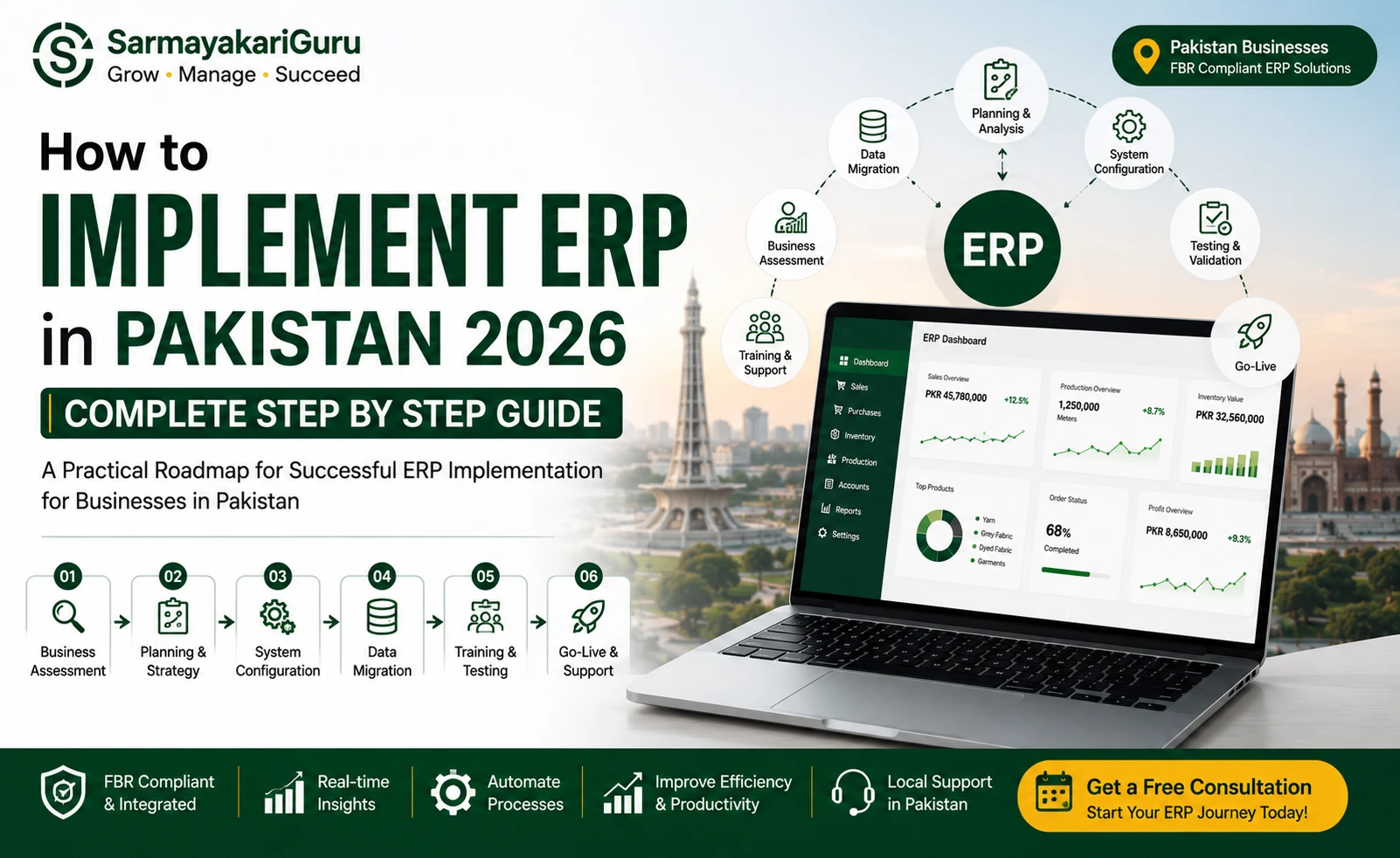
For established Daraz sellers at 30+ daily orders, the conversation is not whether to implement ERP but how quickly. Book a free demo with our e-commerce ERP team and we will connect your Daraz Seller Center live during the call — so you can see exactly how order sync, inventory management, and COD tracking work for your specific account.