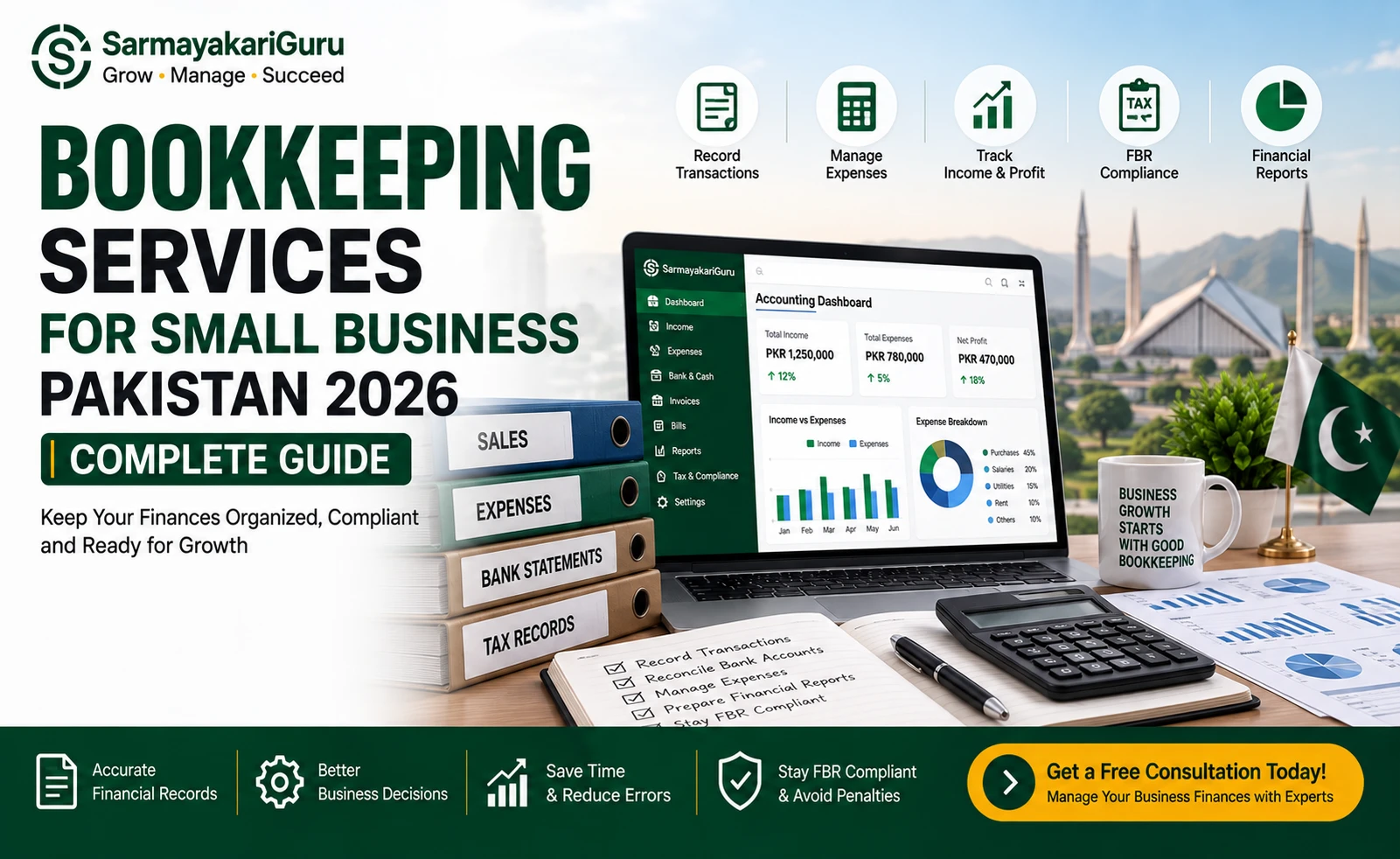

Most Pakistani small business owners do not have a bookkeeping problem. They have a bookkeeping avoidance problem.
The books get updated when the accountant visits — usually at month end, usually in a rush, usually from memory and a pile of receipts that somehow survived the last thirty days. The result is financial records that are technically complete but practically useless — because by the time the numbers are ready, the decisions they should have informed have already been made.
Professional bookkeeping services for small business in Pakistan solve this by keeping your records current continuously, not retrospectively. This guide explains what proper bookkeeping actually involves, why it matters beyond FBR compliance, what it costs, and how to choose the right service for your business.
What Does Bookkeeping for Small Business Include?
Bookkeeping is the day-to-day recording of every financial transaction your business makes. Not monthly. Not quarterly. Every transaction — every sale, every purchase, every payment, every receipt — recorded accurately and promptly.
For a Pakistani small business, professional bookkeeping covers:
Daily transaction recording — sales invoices, purchase receipts, cash payments, bank transfers, and expenses recorded in your accounting system as they happen. When your accountant prepares your monthly statements, there is nothing to reconstruct — it is already done.
Bank reconciliation — matching your accounting records against your actual bank statements every month. This catches errors, unrecorded transactions, and fraud before they become larger problems. A business whose books are never reconciled against the bank is operating blind.
Accounts receivable tracking — recording every sales invoice, tracking which customers have paid and which are outstanding, and flagging overdue amounts for follow-up. Cash flow problems in small businesses almost always trace back to untracked receivables.
Accounts payable management — recording what you owe suppliers, ensuring payments are made on time, and maintaining the clean payment history that builds supplier trust and credit terms.
Payroll recording — posting monthly salary payments, EOBI contributions, PESSI deductions, and income tax withholding to your accounting records. Every payroll run should create corresponding accounting entries automatically. Our SME ERP and accounting package handles payroll as part of integrated bookkeeping.
Monthly financial statements — profit and loss statement, balance sheet, and cash position delivered every month so you know how your business is performing — not how it was performing three months ago when your accountant last compiled the numbers.
Why Bookkeeping Matters Beyond FBR Compliance
The most common reason Pakistani small business owners give for wanting bookkeeping is “to keep FBR happy.” This is a valid reason — but it is the least valuable one.
Clean bookkeeping is business intelligence. When your books are maintained properly, you can answer questions that determine whether your business succeeds or fails.
Which products or services are actually profitable? A retail business that tracks gross revenue but not cost of goods sold and returns does not know which products are making money and which are eating into margins. Bookkeeping that properly allocates costs gives you this visibility.
Is your business generating cash or consuming it? Profit and cash flow are different things, and many Pakistani businesses that appear profitable are actually cash-flow negative because receivables are not being collected promptly or inventory is being held too long. Proper bookkeeping makes cash flow visible — not as a surprise at the end of the quarter, but as a daily reality you can manage.
Can you qualify for a bank loan? Banks in Pakistan require at least two years of organized financial statements for business loan applications. A business with clean, consistent bookkeeping records is immediately credible to a lender. A business that produces a hastily assembled set of accounts when asked is immediately suspicious. Our accounting and taxation services maintain the quality of records that satisfy bank credit departments.
What is your actual tax liability? Without proper bookkeeping, your income tax return is guesswork. Business owners consistently overpay income tax when their expense records are incomplete because they cannot document deductions they are legitimately entitled to claim. Every undocumented business expense increases your taxable profit unnecessarily.
Bookkeeping and FBR Compliance for Pakistani Small Businesses
FBR’s requirements for record-keeping have become more specific and more enforced in recent years. Understanding what FBR actually requires helps you ensure your bookkeeping meets the standard.
FBR requires businesses to maintain records for at least five years from the date of filing. These records must include:
Sales invoices issued — with date, buyer details, amount, and applicable tax for each transaction. For businesses registered for sales tax, invoices must include your STRN and comply with FBR’s format requirements including, for many businesses, digital invoicing with IRN numbers and QR codes.
Purchase invoices received — particularly important for sales tax-registered businesses claiming input tax credit. Only purchases from FBR-registered suppliers with valid STRNs qualify for input tax claims. Every input tax claim in your monthly sales tax return must be supported by a proper purchase invoice.
Bank statements and deposit slips — FBR cross-matches bank data with declared income. Business bank accounts that show regular deposits not reflected in your income tax return are a common trigger for FBR notices.
Payroll records — salary slips, EOBI payment records, and withholding tax statements for all employees. Check your employees’ ATL status at atl.fbr.gov.pk — their filer status affects your withholding tax calculation.
Stock records — for businesses with physical inventory, FBR expects opening stock, purchases, and closing stock to reconcile with your declared cost of goods sold. Large unexplained inventory discrepancies attract scrutiny.
Professional bookkeeping ensures all these records are maintained in the format FBR requires, organized and accessible if FBR ever requests them. The cost of producing organized records during an audit is significantly less than the cost of reconstructing disorganized records under pressure.
How Much Do Bookkeeping Services Cost for Small Business in Pakistan?
Bookkeeping pricing in Pakistan varies widely. Here is an honest picture of what different arrangements actually cost:
In-house bookkeeper — Rs. 30,000 to Rs. 60,000 per month in salary for a competent bookkeeper in a major city. Add EOBI, benefits, computer, software, and office space — real cost is Rs. 45,000 to Rs. 80,000 monthly. And if they leave, your records leave with them.
Part-time visiting accountant — Rs. 10,000 to Rs. 25,000 per month for someone who visits two or three times per week. Works for very low transaction volumes. Creates dependency on one individual. Records are inaccessible between visits.
Outsourced bookkeeping service — Rs. 8,000 to Rs. 25,000 per month depending on transaction volume and what is included. Professional expertise, cloud access to your own records, monthly statements as standard, and no dependency on a single individual.
SarmayakariGuru’s bookkeeping packages for Pakistani small businesses:
| Package | Price | Includes |
|---|---|---|
| Starter | Rs. 8,000/month | Bookkeeping up to 100 transactions, monthly P&L |
| Growth | Rs. 15,000/month | Bookkeeping + cloud ERP + FBR/PRA sales tax return |
| Professional | Rs. 25,000/month | Full bookkeeping + ERP + payroll + SECP compliance |
Book a free consultation to discuss which package fits your transaction volume and business type.
Cloud Bookkeeping vs Traditional Methods
The Pakistani bookkeeping market is shifting rapidly towards cloud-based systems — and for good reason.
Traditional bookkeeping in Pakistan — a physical ledger or a desktop accounting software on one computer — creates fundamental problems. Your records are accessible only in your office, on one computer, to whoever has access to that computer. Backups depend on someone remembering to do them. When the hard drive fails — and hard drives do fail — your financial history may be gone.
Cloud-based bookkeeping solves all of these problems. Your records are accessible from any device, from any location. Backups happen automatically. Your accountant and you can access the same records simultaneously without physical coordination. And when you switch from one device to another, your complete financial history moves with you instantly.
For businesses that sell on Daraz, Shopify, or other e-commerce platforms, cloud bookkeeping integrated with your sales channels automatically records every order and payment — eliminating hours of manual data entry every month. Our e-commerce ERP integrates sales channels directly with bookkeeping for Pakistani online sellers.
For retail businesses, cloud bookkeeping integrated with POS means every sale at your counter automatically creates an accounting entry — your books are current in real time, not compiled from POS reports at month end. Our retail ERP combines POS with bookkeeping for Pakistani retail businesses.
How to Choose a Bookkeeping Service for Your Small Business in Pakistan
The quality of bookkeeping services in Pakistan varies enormously. Here is what actually matters when making your choice.
Monthly reports as standard — not optional. Your bookkeeping service should deliver a profit and loss statement and basic balance sheet every month without you having to ask for it. If a service maintains your records but cannot tell you whether you made a profit last month, you are getting data storage, not bookkeeping.
FBR knowledge is non-negotiable. Ask specifically about FBR’s digital invoicing requirements, sales tax input tax rules, and withholding tax documentation requirements. A bookkeeper who cannot discuss these confidently is not equipped for Pakistan’s current compliance environment. The FBR official website publishes current requirements — your bookkeeper should know them.
Cloud access for you. You should be able to see your own financial records at any time — not just when your bookkeeper sends you a report. If a service keeps your books in a system only they can access, that is a dependency you should not accept.
Integration with tax filing. The most efficient arrangement is when your bookkeeper and your tax accountant are the same team — or work in the same system. This eliminates the reconciliation gap between maintained records and filed returns that causes most FBR notice triggers.
Clear, transparent pricing with defined scope. Get in writing exactly what is included — the monthly transaction limit, which reports are delivered, whether FBR filing is extra, and what happens if your transaction volume grows. Hidden costs that appear after the relationship starts are the most common complaint about bookkeeping services in Pakistan.
Getting Started with Bookkeeping Services
The right time to start proper bookkeeping is before you need it — not when FBR sends a notice or a bank asks for your financials.
For businesses that have been operating without proper books, SarmayakariGuru’s team can reconstruct and organize historical records alongside setting up proper ongoing bookkeeping — creating a clean starting point without requiring you to have maintained perfect records previously.
For new businesses, starting with professional bookkeeping from day one is significantly cheaper than trying to organize disorganized historical records later. The setup cost is low and the ongoing benefit — clean records, FBR compliance, monthly visibility into your business performance — compounds over time.
Our SME solutions page details the complete packages available for Pakistani small businesses combining bookkeeping, ERP software, and FBR tax filing in one monthly subscription.