

You are managing stock levels in your head. Your accountant visits once a month and spends three days untangling your Excel sheets. Your sales staff is updating inventory on WhatsApp. And every time FBR filing season comes around, you spend a week digging through invoices trying to figure out what you actually owe.
Sound familiar?
If it does, you are not alone. This is exactly how most Pakistani small businesses operate — and it works, until it doesn’t. Until you miss a major stockout and lose a big order. Until your bookkeeper makes an error and you get an FBR notice. Until you try to open a second branch and realize your entire business is running on tribal knowledge and WhatsApp groups.
That is where ERP software comes in.
But here is the honest truth: most ERP guides you will find online are either written for large enterprises or are thinly disguised sales pitches. This one is different. We are going to talk specifically about what works for Pakistani small businesses — with real prices in rupees, real local support expectations, and an honest look at what you actually need versus what vendors will try to sell you.
Let us start from the beginning.
What Does a Small Business in Pakistan Actually Need from ERP?
Before we compare any software, let us get clear on what you actually need. Because the biggest mistake small business owners make with ERP is buying far more than their business requires — and then never using 80% of the features while paying for all of them.
Here is what a typical Pakistani small business genuinely needs:
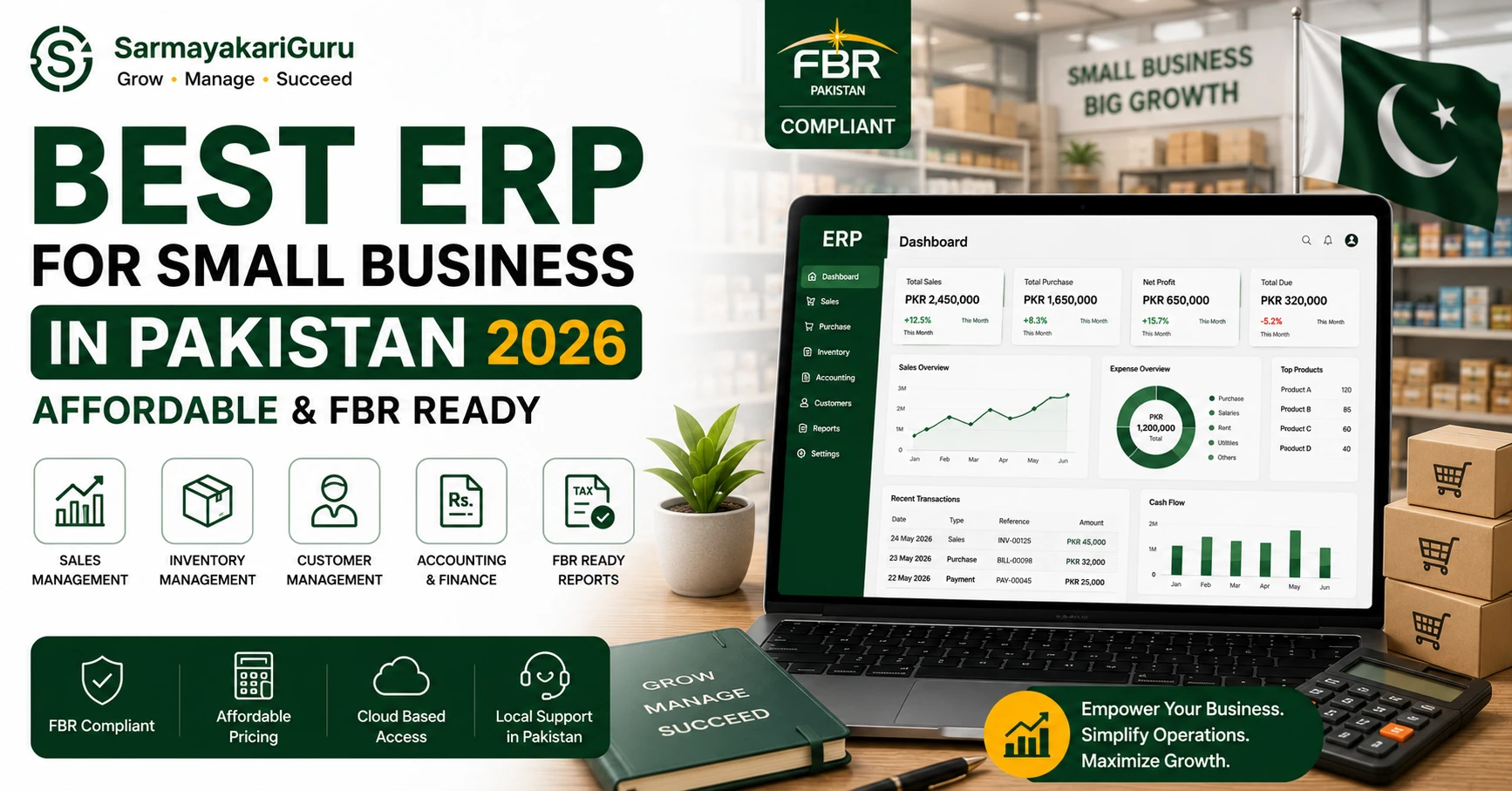
Inventory management — knowing what you have in stock at any given moment, getting alerts before you run out, and tracking what came in and what went out.
Sales and invoicing — generating proper invoices quickly, tracking which customers owe you money, and following up on overdue payments.
Basic accounting — recording income and expenses, seeing a profit and loss statement every month, and having clean records for your accountant.
FBR tax compliance — generating sales tax invoices, tracking your tax liability, and making your monthly returns easier to prepare.
Payroll — calculating staff salaries, EOBI deductions, and generating payslips without doing it manually every month.
That is genuinely it for most small businesses. You do not need production planning modules, complex BOM management, or multi-currency treasury systems on day one. Start with what you need and build from there.
📋 Not sure which ERP plan fits your business size? Explore our SME ERP solutions — we have packages designed specifically for small Pakistani businesses starting from Rs. 15,000 per month.
Why Most International ERP Systems Are Wrong for Pakistani Small Businesses
This is the conversation nobody in the ERP industry wants to have — but someone needs to.
International ERP brands like SAP, Oracle, and Microsoft Dynamics are genuinely excellent software. But they were built for large enterprises in developed markets. When you try to use them in Pakistan, you run into the same problems every time.
The tax problem. Pakistan has one federal tax authority (FBR) and four provincial ones — PRA in Punjab, SRB in Sindh, KPRA in KPK, and BRA in Balochistan. International systems do not know any of these exist. You have to pay consultants to build the tax logic from scratch, which takes months and costs lakhs.
The price problem. SAP Business One starts at roughly Rs. 2.5 million per year for the license alone. Oracle NetSuite is similar. That is before implementation costs, which typically add another Rs. 5 to 10 million. For a small business, this is simply not viable.
The support problem. When your system breaks at 9 AM on a Monday and you have customers waiting — you need someone who picks up the phone in Pakistan, speaks Urdu, and understands your business context. International vendors offer remote support with long ticket queues and response times measured in days, not hours.
The load shedding problem. Pakistan’s power situation is a reality of business life. A cloud ERP that goes completely offline during a power outage is a problem. You need offline capability that syncs when connectivity returns.
These are not minor inconveniences. They are deal-breakers for Pakistani small businesses. Keep them in mind as you evaluate your options.
The 4 Realistic ERP Options for Pakistani Small Businesses
Option 1 — SarmayakariGuru ERP (Best Overall for Pakistani SMEs)
We built SarmayakariGuru ERP because we kept running into the same problem with our accounting clients. They needed ERP software, but everything available was either too expensive, not FBR-compliant out of the box, or had no local support. So we built what Pakistan’s small businesses actually needed.
Here is what makes it work specifically for small businesses:
You do not need a large upfront investment. Our SME package starts at Rs. 25,000 setup with Rs. 15,000 per month — that is less than the cost of a part-time employee, and it replaces the work of several.
FBR compliance is built in. Every invoice generated is FBR-compliant. Sales tax calculations for all four provincial authorities are automatic. Your monthly returns become significantly easier to prepare because all the data is already in the system.
It works in Urdu. Your cashier or stock manager does not need to be an English speaker to use the system. The interface is available in Urdu for operational staff, while management reporting is in English.
It works offline. Load shedding happens. Our system keeps working and syncs everything when connectivity returns.
You get real humans for support. Every client gets a dedicated WhatsApp support line — answered by actual people who understand Pakistan’s business environment — six days a week.
And here is the part that is truly unique: we combine the ERP software with professional accounting and FBR tax filing services. The same team that built your system also handles your monthly sales tax returns and annual income tax filing. One relationship. One bill. No gaps.
👉 See all SME ERP features and pricing 👉 Book a free 30-minute ERP demo
Starting price: Rs. 25,000 setup + Rs. 15,000/month Best for: Retail shops, small manufacturers, service businesses, e-commerce sellers
Option 2 — GENTEC ERP
GENTEC is a well-established Pakistani ERP vendor with over a thousand implementations behind them. They have been in the market for a long time and their track record is genuine.
For medium to large businesses — particularly manufacturers — GENTEC deserves serious consideration. Their manufacturing module has depth, and their local presence means you can get on-site support.
For small businesses, the challenge is cost. GENTEC’s pricing starts higher than most SMEs can comfortably absorb, and their interface, while functional, feels dated compared to newer cloud-native systems.
Starting price: Rs. 100,000+ setup Best for: Medium-sized manufacturers and distributors who can absorb higher implementation costs
Option 3 — Odoo Community Edition (Free but Complex)
Odoo’s community edition is technically free, which makes it attractive at first glance. It is modern, well-designed, and has a large global user community.
The catch is that “free” only means the software license. You still need to host it (cost), configure it for Pakistan’s tax system (cost and time), add FBR-specific modules that are not built in (cost), and maintain it ongoing (cost).
For a small business owner without a technical background, Odoo community typically becomes a money pit. For a business with a technical co-founder or an in-house developer — it is absolutely worth exploring.
Starting price: Free license, but Rs. 100,000+ in setup and customization typically Best for: Tech startups and businesses with in-house development resources
Option 4 — QuickBooks (For Micro Businesses Only)
QuickBooks comes up in almost every conversation about small business software in Pakistan, so it needs to be addressed directly.
QuickBooks is accounting software — not ERP. It handles bookkeeping and invoicing well. But it has no inventory management worth mentioning, no HR module, no production capability, and limited FBR compliance features.
If you are a freelancer, a consultant, or a very small service business that only needs basic bookkeeping — QuickBooks is a reasonable starting point. The moment you need to track physical inventory, manage staff payroll properly, or handle multi-location operations — you have outgrown QuickBooks.
Starting price: Rs. 8,000 to Rs. 25,000 per year Best for: Freelancers and micro service businesses only
What Pakistani Small Business Owners Get Wrong About ERP
After years of working with businesses across Pakistan, we keep seeing the same mistakes. Here are the ones that cost businesses the most:
Buying on price alone. The cheapest ERP is rarely the best value. If a system does not have proper FBR compliance, you will spend more fixing tax problems than you saved on software. If it has no local support, one bad system failure can cost you days of lost business.
Overbuying features. A five-person retail shop does not need a manufacturing module, a project management system, or multi-currency treasury management. Buy what you need now and expand later. A good ERP grows with your business.
Skipping the demo. Every serious ERP vendor will give you a demo. Use it. Ask them to show you specifically how FBR sales tax is calculated, how EOBI is deducted from payroll, and how your monthly sales tax return data is generated. If they cannot show you these things clearly, walk away.
Ignoring data migration. If you have years of inventory data, customer records, and supplier information in Excel — ask specifically how the ERP handles data migration. A vendor who dismisses this with “we will figure it out” is waving a red flag.
Not involving your staff. The biggest ERP failures happen when management buys a system and employees refuse to use it properly. Your staff, especially warehouse workers and cashiers, need to be part of the evaluation process. A system that makes their life harder will be quietly sabotaged.
How Much Should a Small Business in Pakistan Spend on ERP?
This is the question everyone wants answered, so let us be direct.
For a small Pakistani business with 5 to 20 employees and one or two locations, a reasonable ERP budget is:
One-time setup cost: Rs. 25,000 to Rs. 75,000 Monthly operational cost: Rs. 15,000 to Rs. 25,000 per month
At Rs. 15,000 per month, you are spending Rs. 180,000 per year on ERP. That is less than one month’s salary for a mid-level accounts manager — and a good ERP does the work of at least two to three people in terms of data accuracy and time savings.
When you factor in the time saved on manual bookkeeping, the reduction in billing errors, the elimination of stock discrepancies, and the cleaner FBR returns — the ROI is usually visible within the first three to six months.
Want to calculate whether ERP makes financial sense for your business? Talk to our ERP consultants — the first call is free
ERP for Specific Small Business Types in Pakistan
Not all small businesses have the same needs. Here is a quick guide by business type:
Retail shop or general store: You need POS integration, barcode scanning, daily sales reconciliation, and FBR receipt generation. Multi-branch stock visibility if you have more than one location.
Small manufacturer: You need bill of materials (BOM), basic production planning, raw material tracking, and finished goods inventory. EOBI-compliant payroll for your factory workers is essential.
Online seller (Daraz, Shopify, WooCommerce): You need automatic order sync from all platforms, real-time inventory updates across channels, and COD payment tracking from TCS, Leopards, and other couriers.
Service business (clinic, agency, consultancy): You need invoicing, payment tracking, basic HR and payroll, and income/expense recording. You probably do not need inventory management at all.
5 Questions to Ask Before You Buy Any ERP in Pakistan
Before you sign any agreement, make sure you get clear answers to these:
1. Is FBR compliance — including all four provincial tax authorities — built into the system, or does it require customization? If customization is required, get the timeline and cost in writing before signing.
2. What is the exact monthly cost, and what does it include? Get a complete breakdown — software license, hosting, support, training, and updates. Hidden costs are common in the industry.
3. Who provides support, how quickly do they respond, and is there a physical presence in Pakistan? Ask for the WhatsApp number or support contact you will actually use after purchase — not the sales team’s number.
4. Can I see a demo using my actual products, my tax setup, and my business scenario? Generic demos are easy. A vendor confident in their product will personalize the demo to your business.
5. What happens to my data if I decide to leave? You should always be able to export your complete data in a standard format. Vendor lock-in is a real risk.
Frequently Asked Questions
The Bottom Line
If you are a Pakistani small business owner in 2026, you do not need to choose between “too expensive and feature-heavy” or “too basic and manual.” There are genuine options in the middle that are built for your reality — your tax laws, your budget, your language, and your support expectations.
The best ERP for your small business is the one your team will actually use, that handles Pakistan’s FBR compliance without customization headaches, and that comes with local support you can reach on WhatsApp when something goes wrong.
Take your time. Get demos from at least two vendors. Ask the hard questions. And make sure you see the FBR tax module working before you commit to anything.
📞 Book a free 30-minute ERP demo with SarmayakariGuru — we will show you exactly how our system works for your specific business type, with your product categories and Pakistan’s tax setup configured live.
👉 Book Free Demo — No Commitment Required ⚙️ Explore All ERP Solutions 📋 ERP + Accounting Services Combined 🧮 Free Business Tax Calculator