
If you search “best ERP software in Pakistan” right now, you will find dozens of articles — most written by the same companies trying to sell you their own product. They will all tell you they are the best. They will all promise the world.
This article is different.
We are going to give you an honest, practical comparison of the ERP options available to Pakistani businesses in 2026 — including our own. We will tell you what each system does well, what it does not, and most importantly, which one actually makes sense for your specific situation.
Because here is the truth: the best ERP software is not the most expensive one, or the most famous one. It is the one that fits your business, your budget, and Pakistan’s unique business environment.
First — What Even Is ERP Software?
ERP stands for Enterprise Resource Planning. It sounds complicated, but the concept is simple.
Imagine you run a business. You have inventory in a warehouse. You have staff who need to be paid. You have customers who owe you money. You have suppliers you owe money to. You have FBR tax returns to file every month. And somehow, you are trying to track all of this — probably across WhatsApp messages, Excel sheets, and a notebook.
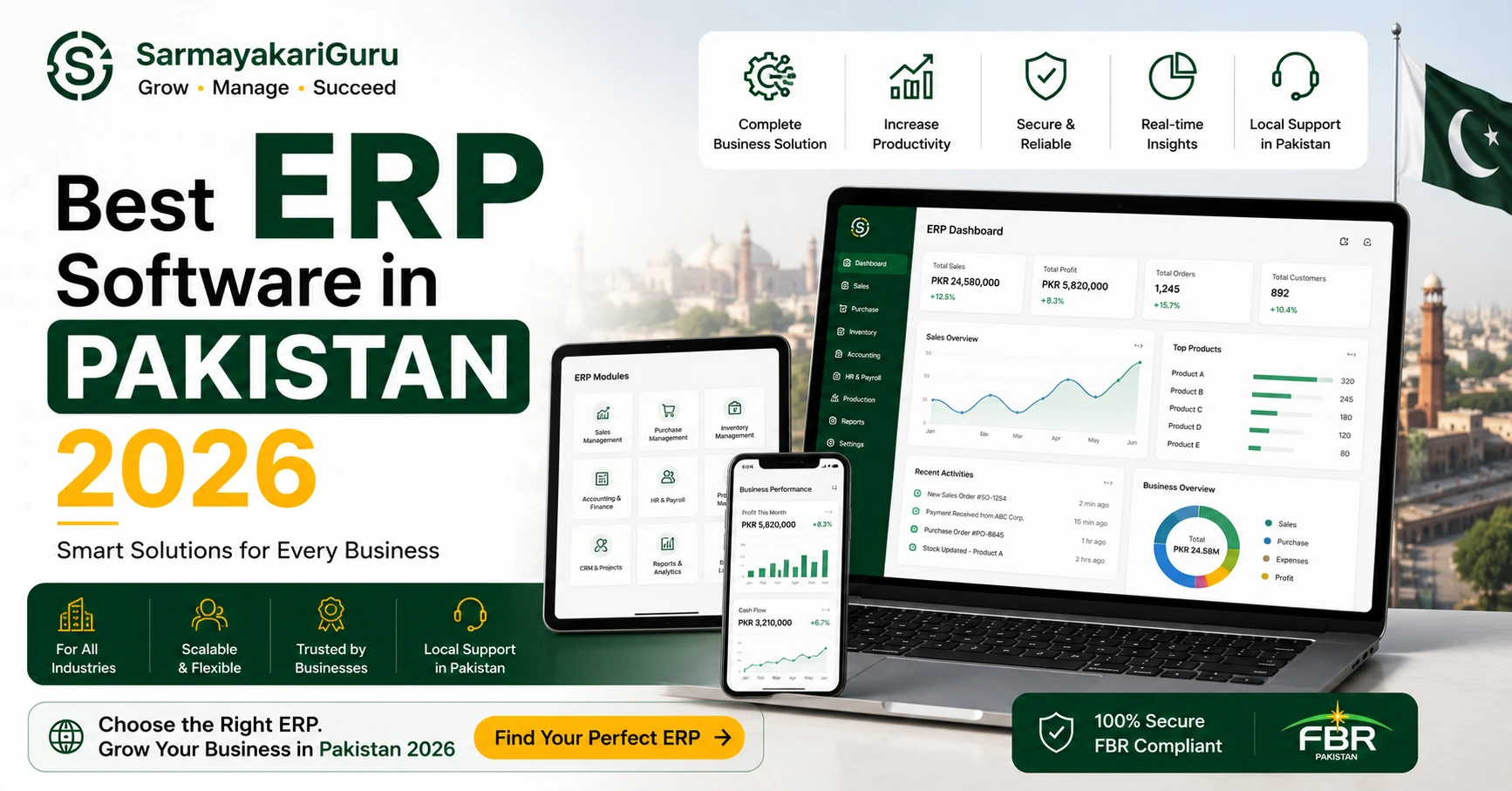
ERP software brings all of this into one system. One screen that shows you your stock levels, your sales, your expenses, your payroll, and your tax liability — all updated in real time.
Done right, ERP transforms how a business operates. Done wrong — or with the wrong system — it becomes an expensive headache.
So let us make sure you choose right.
What Makes ERP Software “Good” for Pakistan Specifically?
This is the most important question — and most international comparisons completely ignore it.
Pakistani businesses have unique requirements that most global ERP systems simply do not account for:
FBR Tax Compliance Your ERP needs to calculate FBR sales tax, income tax withholding, and handle all four provincial tax authorities — PRA in Punjab, SRB in Sindh, KPRA in KPK, and BRA in Balochistan. International systems require months of expensive customization to get this right. Pakistan-built systems have it built in from day one.
EOBI and Pakistan Labour Law Your HR and payroll module must calculate EOBI contributions, PESSI deductions, and overtime pay as per Pakistan Labour Law — not some international standard.
Local Support in Pakistan When your system breaks down at 10 AM on a busy Monday — and trust me, at some point it will — you need someone who picks up the phone in Pakistan. Not a support ticket system that gets answered 48 hours later from a call center in another country.
Urdu Language Support Not all your staff speak fluent English. A good ERP for Pakistan should have Urdu interface options for shop floor workers and cashiers.
Price in Pakistani Rupees International ERP systems are priced in USD. With the current exchange rate, annual licenses can cost Rs. 2 to 5 million for even basic packages. That is not realistic for most Pakistani businesses.
Offline Functionality Pakistan’s power and internet situation means your ERP cannot afford to go down every time there is a load shedding. A good local system should have offline capability that syncs when connectivity returns.
Keep these six points in mind as we go through each option.
Best ERP Software Options in Pakistan 2026
1. SarmayakariGuru ERP — Best Overall for Pakistani SMEs
We will start with ourselves — and we will be honest about both the strengths and the limitations.
SarmayakariGuru ERP is a cloud-based system built specifically for Pakistani businesses. We developed it because we kept seeing our accounting clients struggle with international ERP systems that were not designed for Pakistan’s tax laws and business environment.
What we do well:
Every module comes pre-configured for Pakistan — FBR sales tax, all four provincial tax authorities, EOBI payroll calculations, and SECP compliance documentation. You do not pay extra for “localization.” It is already there.
We also offer something no other ERP company in Pakistan does: we bundle the software with professional accounting and FBR tax filing services. This means the same team that built your ERP is also filing your monthly sales tax returns and annual income tax. One bill. One point of contact. No gaps between your software and your compliance.
Our Daraz, Shopify, and WooCommerce integration is native — built for Pakistani e-commerce sellers who deal with COD payments, TCS and Leopards remittances, and Daraz commission reconciliation.
We have an offline mode for power outages, Urdu language interface for shop floor staff, and on-site support in Karachi, Lahore, Islamabad, Faisalabad, and beyond.
Where we have limitations:
We are not the right fit for very large corporations — multinationals with complex multi-country operations and a Rs. 10 million+ IT budget would be better served by SAP or Oracle. We are built for Pakistan’s SME market — retail businesses, manufacturing units, e-commerce brands, and growing companies.
Pricing: One-time setup from Rs. 25,000 + Rs. 15,000 to Rs. 25,000 per month depending on plan.
Best for: Retail businesses, SMEs, e-commerce sellers on Daraz/Shopify, manufacturing units, service businesses.
2. GENTEC ERP — Best for Large Pakistani Manufacturers
GENTEC has been around for a long time and has done over 1,000 ERP implementations across Pakistan. That is a significant track record and it deserves respect.
Their manufacturing module is particularly strong — they have deep experience with Pakistan’s textile industry, food processing, and pharmaceutical sectors.
Strengths: Established reputation, strong manufacturing module, local team, extensive implementation experience.
Weaknesses: The interface feels dated compared to newer cloud systems. Pricing is on the higher end — not accessible for smaller businesses. E-commerce integrations with Daraz and Shopify are limited.
Pricing: Rs. 100,000+ setup, higher monthly fees.
Best for: Medium to large manufacturing companies that prioritize an established vendor with a proven track record.
3. SAP Business One — For Large Enterprises Only
SAP is the world’s most widely used ERP system. If you are a large Pakistani corporation with international operations and a massive IT budget — SAP might make sense.
But let us be honest about what SAP actually costs in Pakistan.
The annual license alone starts at around Rs. 2.5 million — and that is before implementation. SAP implementations in Pakistan typically cost Rs. 5 to 15 million in consulting fees, take 12 to 18 months to complete, and require ongoing monthly support from certified SAP partners.
Then there is the localization issue. SAP does not come with Pakistan’s FBR sales tax, EOBI payroll, or provincial tax authorities built in. You pay additional consulting fees to customize these — which can add months to your implementation timeline.
The honest verdict: SAP is an excellent system for the 1% of Pakistani businesses that truly need it. For the other 99%, it is overkill and an unnecessary financial burden.
Pricing: Rs. 2,500,000+ per year just for the license.
Best for: Large corporations and multinationals with Rs. 50M+ IT budgets and complex international operations.
4. Oracle NetSuite — Same Story as SAP
NetSuite is Oracle’s cloud ERP and it is genuinely excellent software. But the same concerns apply.
Pricing in USD means you are looking at Rs. 3 million or more per year. No built-in FBR or Pakistan tax compliance. Support is remote — there is no Oracle team physically present in Pakistan to help you when things go wrong.
If your business has significant international operations and needs a system that handles multiple countries and currencies seamlessly — NetSuite deserves consideration. Otherwise, it is hard to justify the cost.
Pricing: Rs. 3,000,000+ per year.
Best for: Large Pakistani companies with international operations and strong in-house IT teams.
5. Odoo — The Open Source Option
Odoo is interesting because the community edition is technically free. It is an open-source ERP with a large global user base and a genuinely modern interface.
Here is the reality though.
“Free” Odoo requires a technical team to install, configure, and maintain. FBR tax compliance needs to be custom-developed — which costs money and takes time. When something breaks, you are relying on community forums or expensive freelance developers.
The enterprise edition of Odoo is reasonably priced, but again comes with the localization challenge. Pakistan-specific tax and payroll modules need custom development.
If you have a technical co-founder or a strong in-house IT team — Odoo is worth exploring. If you are a business owner who just needs something that works out of the box for Pakistan — Odoo will frustrate you.
Pricing: Free (community) to Rs. 200,000+ per year (enterprise) — plus significant customization costs.
Best for: Tech startups and companies with in-house development teams who can handle customization.
6. QuickBooks — It Is Not Really ERP
We need to address QuickBooks because a lot of Pakistani business owners consider it an ERP option. It is not.
QuickBooks is accounting software. It handles bookkeeping, invoicing, and basic financial reporting very well. But it has no inventory management, no HR module, no production planning, and no CRM.
The moment your business needs to track stock across multiple locations, manage employee attendance, or handle purchase orders — QuickBooks hits a wall.
Use QuickBooks if you are a freelancer or a very small business that only needs basic bookkeeping. Graduate to a proper ERP when your operations grow beyond that.
Pricing: Rs. 8,000 to Rs. 25,000 per year.
Best for: Freelancers and micro-businesses needing basic bookkeeping only.
7. Microsoft Dynamics 365 — Powerful but Expensive
Dynamics 365 is Microsoft’s enterprise ERP and CRM platform. If your business is deeply embedded in the Microsoft ecosystem — Office 365, Teams, Power BI, Azure — Dynamics integrates beautifully with all of these.
The challenges in Pakistan are the same as SAP and Oracle: pricing in USD (Rs. 1.5 million+ per year), no built-in FBR compliance, and limited local Pakistan support from certified Dynamics partners.
Pricing: Rs. 1,500,000+ per year.
Best for: Large corporations already heavily invested in the Microsoft ecosystem.
Side-by-Side Comparison — All 7 Systems
| System | FBR Built-In | Local Support | Starting Price (PKR) | Offline Mode | Urdu UI | Best For |
|---|---|---|---|---|---|---|
| SarmayakariGuru | ✅ Yes | ✅ Yes | Rs. 25,000 setup | ✅ Yes | ✅ Yes | SMEs, retail, e-commerce |
| GENTEC | ✅ Yes | ✅ Yes | Rs. 100,000+ | ⚠️ Partial | ❌ No | Large manufacturers |
| SAP Business One | ❌ Custom | ⚠️ Limited | Rs. 2,500,000+/yr | ❌ No | ❌ No | Large enterprises |
| Oracle NetSuite | ❌ Custom | ❌ Remote | Rs. 3,000,000+/yr | ❌ No | ❌ No | Multinationals |
| Odoo | ❌ Custom | ⚠️ Limited | Free to Rs. 200,000+ | ⚠️ Partial | ❌ No | Tech startups |
| QuickBooks | ⚠️ Partial | ❌ No | Rs. 8,000/yr | ❌ No | ❌ No | Micro businesses |
| Microsoft Dynamics | ❌ Custom | ⚠️ Limited | Rs. 1,500,000+/yr | ❌ No | ❌ No | Large enterprises |
How to Actually Choose — A Decision Framework
Stop overthinking it. Here is a simple way to decide:
If you are a small business with under 20 employees and a budget under Rs. 30,000 setup: Start with SarmayakariGuru’s SME package — cloud ERP bundled with bookkeeping and tax services from Rs. 15,000/month. No large upfront cost.
If you run a retail shop or supermarket chain: You need POS integration, multi-branch inventory, and FBR receipt generation. SarmayakariGuru Retail ERP or GENTEC are your two realistic options.
If you are a manufacturer — textile, food, pharma, electronics: Your needs are more complex. SarmayakariGuru Manufacturing ERP covers BOM, production planning, and quality control for Pakistan’s mid-size manufacturers. GENTEC is the alternative for large-scale operations.
If you sell on Daraz, Shopify, or WooCommerce: You need native Pakistan e-commerce integration — Daraz sync, COD tracking from TCS and Leopards, and automatic inventory updates. Only SarmayakariGuru offers this natively for Pakistani sellers.
If you are a large corporation with international operations: Honestly evaluate SAP Business One or Oracle NetSuite — but budget Rs. 5 to 15 million for implementation and expect 12 to 18 months to go live.
The Questions You Should Ask Any ERP Vendor
Before you sign anything, ask every vendor these five questions:
1. Is FBR sales tax, PRA, SRB, KPRA, and BRA compliance already built in — or does it need customization? If they say “customization required” — add 3 to 6 months and Rs. 200,000+ to your budget estimate.
2. Who provides support when something breaks? What is the response time? Is there someone in Pakistan? Get this in writing before you sign.
3. Can I see a live demo using my actual product categories and tax setup? Any serious vendor should be able to do this within 48 hours.
4. What happens to my data if I stop using your software? You should always be able to export your complete data in a standard format. Do not get locked in.
5. Do you have references from businesses similar to mine that I can contact? References from actual Pakistani customers in your industry are worth more than any brochure.
Red Flags to Watch Out For
We have seen Pakistani business owners make expensive ERP mistakes. Here are the warning signs:
“Implementation is free” — Nothing is free. Either it is bundled into an inflated monthly fee or corners are being cut on setup that will cost you later.
Vague pricing — If a vendor will not give you a clear price after your initial meeting, something is off. Transparent pricing is a sign of a trustworthy vendor.
No Pakistan-specific demo — If they cannot show you FBR sales tax calculation, EOBI payroll deduction, and provincial tax handling in a demo — they have not done the localization work.
“We will customize it for you” — Customization delays, costs overrun, and creates software that breaks with every update. Prefer a vendor whose Pakistan compliance is a standard built-in feature.
Final Recommendation
For the vast majority of Pakistani businesses reading this — the right answer is a Pakistan-built cloud ERP that comes with FBR compliance pre-configured, local support, and transparent pricing in PKR.
Whether that is SarmayakariGuru, GENTEC, or another local option — prioritize local expertise over international brand recognition every time. The software that understands Pakistan’s tax system, speaks Urdu, and has someone you can call in Lahore at 9 AM is almost always the better choice for a Pakistani business.
If you want to see what SarmayakariGuru ERP looks like for your specific business — book a free 30-minute demo. We will connect your Daraz store, or configure your inventory, or set up your payroll live during the call so you can see exactly what you are getting before committing to anything.
📞 Book Free ERP Demo — No Commitment ⚙️ Explore All ERP Solutions 📋 ERP + Accounting Services Combined 🧮 Free Business Tax Calculator