
The owner is frustrated. Stock records are wrong — again. The accountant is asking for last month’s invoices but nobody knows where they are. The sales team is taking orders on WhatsApp while the warehouse team is working from a completely different list. And FBR filing season is three weeks away.
Sound familiar?
This is the reality of thousands of Pakistani businesses in 2026 — and the reason cloud ERP Pakistan has gone from a “nice to have” to an absolute necessity. Not just for large corporations. For retail shops in Lahore, manufacturers in Faisalabad, e-commerce sellers on Daraz, and service businesses in Karachi.
In this article, we are going to explain exactly what cloud ERP is, why Pakistan’s business environment in 2026 makes it more relevant than ever, what to look for when choosing one, and what mistakes Pakistani businesses make when they first adopt it.
What Is Cloud ERP — In Simple Terms
Let us skip the jargon.
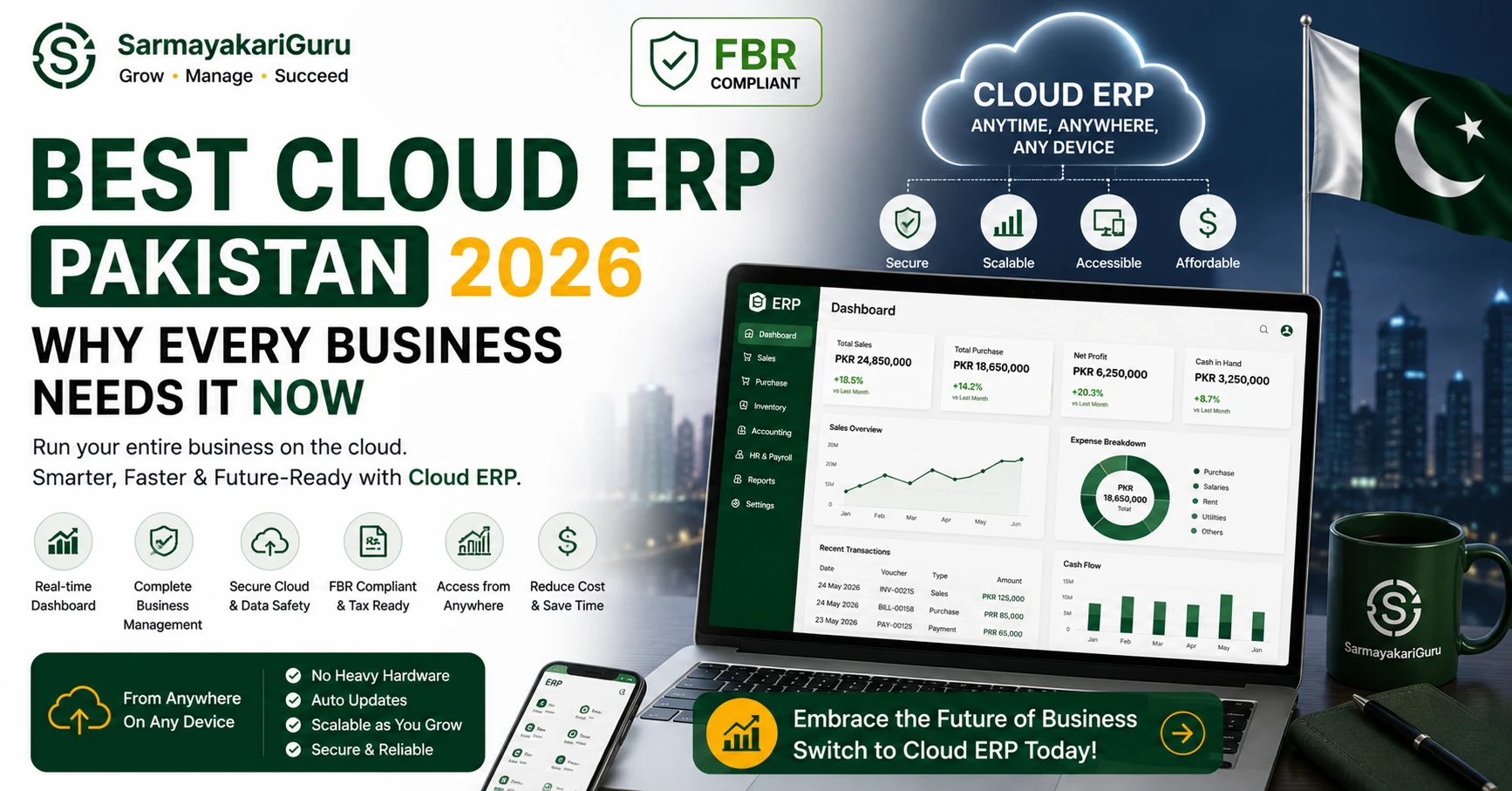
Cloud ERP is software that runs on the internet — not on a computer in your office. It connects every part of your business — inventory, sales, purchases, HR, payroll, accounting, and tax compliance — into one system that everyone on your team can access from anywhere, at any time, on any device.
The “cloud” part means your data is stored securely on remote servers and accessed through a browser or app. You do not need to install anything, buy expensive hardware, or worry about backups. It just works — whether you are in your office in Karachi, checking numbers from Lahore, or reviewing reports from home at midnight.
The “ERP” part — Enterprise Resource Planning — means it is not just accounting software or just inventory software. It is all of it, connected. When a sale happens at your counter, your inventory updates. Your accounts receivable updates. Your daily revenue report updates. Your tax liability updates. All automatically, all in real time.
That is cloud ERP in plain language.
Why 2026 Is the Year Pakistani Businesses Cannot Ignore Cloud ERP
Several things have converged in 2026 that make cloud ERP particularly urgent for Pakistani businesses. These are not general technology trends — they are specific to Pakistan’s business and regulatory environment right now.
FBR’s digital enforcement is getting serious.
FBR has been steadily expanding its data collection capabilities. Banks report transaction data. Property registrars share records. NADRA links financial activity to CNICs. Daraz and other platforms report seller earnings. The era of operating informally and reconciling everything manually at tax time is coming to an end. If you do not have clean, real-time financial records — generated automatically by a proper system — you are increasingly exposed to FBR notices, audit selections, and penalties.
A good cloud ERP Pakistan system generates FBR-compliant invoices automatically, tracks your tax liability in real time, and makes your monthly sales tax return preparation a matter of minutes rather than days. If you want to understand how your current tax liability looks before your accountant tells you, our free business tax calculator gives you an instant estimate based on Pakistan’s latest FBR slabs.
Pakistan’s e-commerce explosion is creating operational chaos.
Daraz, TikTok Shop, Instagram commerce, WhatsApp orders, and independent Shopify stores — Pakistani businesses are selling through more channels than ever before. Managing inventory manually across even two of these channels is a disaster waiting to happen. You oversell. You undersell. You lose track of COD payments from TCS and Leopards. You cannot tell which products are actually profitable after platform fees and returns.
Cloud ERP connects all these channels in one place. Orders from Daraz sync automatically. Inventory updates across every platform simultaneously. COD remittances are imported and matched to orders without anyone touching a spreadsheet. Our e-commerce ERP solution is built specifically for this scenario — designed for how Pakistani online businesses actually operate.
The cost of staying manual is increasing.
In 2018, operating on Excel and WhatsApp was a workable approach. In 2026, it is a liability. The errors are more expensive. The FBR penalties are higher. The cost of a good employee who manually does the work of a system is rising every year. And perhaps most importantly — the businesses that have adopted cloud ERP are making better decisions faster, which means they are outcompeting those that haven’t.
Cloud ERP vs Traditional ERP — Why Cloud Wins for Pakistan
You might be wondering: what is the difference between cloud ERP and the traditional ERP systems that have been around for decades?
It comes down to four things that matter enormously in Pakistan’s business environment.
Cost. Traditional ERP requires you to buy server hardware, pay for installation, hire IT staff to maintain it, and pay large upfront license fees. Cloud ERP has none of these. You pay a monthly subscription — typically Rs. 15,000 to Rs. 25,000 for most Pakistani SMEs — and everything is handled for you. No IT department needed.
Accessibility. Traditional ERP lives on one server in your office. If you are not there, you cannot access your data. Cloud ERP works on your phone, your tablet, your laptop — from anywhere in Pakistan or the world. If you travel to Islamabad for a meeting and need to check your Lahore warehouse stock levels, you open the app.
Updates. Traditional ERP requires manual updates — often expensive, often disruptive. Cloud ERP updates automatically. When FBR changes tax rates in the next Finance Act, a good cloud ERP Pakistan vendor updates the tax tables and you see the new rates the next morning. You do not pay extra. You do not wait for an IT consultant.
Disaster recovery. If the server in your office gets damaged, stolen, or corrupted — your data is gone. Cloud ERP backs up your data automatically, usually multiple times per day, on secure remote servers. The worst that can happen is a temporary connectivity issue. Your data is always safe.
One concern Pakistani business owners raise about cloud ERP is internet and power reliability. This is a legitimate concern. The best cloud ERP systems for Pakistan have offline modes — the system continues working during power outages and internet disruptions, then syncs everything when connectivity returns. Make sure any system you evaluate has this capability. It is non-negotiable for Pakistani operations.
What Cloud ERP Actually Does — The Features That Matter
Let us be specific about what a cloud ERP Pakistan system should actually do for your business. Not the marketing language — the actual daily reality.
Inventory management that eliminates stockouts.
Every time a product is sold, received from a supplier, returned by a customer, or transferred between locations — your stock levels update instantly. You see a live count of every SKU across every warehouse and branch. When anything falls below the minimum level you set, the system sends an alert and can automatically generate a purchase order. If you run a retail business and want to understand how this integrates with your POS and accounting, our retail ERP solution for Pakistan covers this in detail.
FBR-compliant invoicing without any effort.
Every invoice generated by the system is automatically FBR-compliant — it includes your NTN, STRN, the correct GST or sales tax rate for that product category, and the provincial tax authority applicable to your business. Your monthly sales tax return data is always ready, because the system has been recording it transaction by transaction all month long.
Payroll that handles EOBI automatically.
For any business with employees, payroll is a monthly headache. Cloud ERP processes your payroll automatically — calculating basic salary, overtime, allowances, income tax withholding under Section 149, and EOBI contributions as per Pakistan Labour Law. It generates payslips and maintains the records FBR requires for withholding tax statements. For manufacturing businesses where workforce management is particularly complex, our manufacturing ERP handles shift management and piece-rate calculations as well.
Real-time financial reports without waiting for your accountant.
Your profit and loss statement, balance sheet, and cash flow report are always current — updated with every transaction. You do not wait until the end of the month to find out whether you are making money. You know today. You know which product lines are profitable and which are draining you. You know which customers have outstanding balances and for how long.
Purchase management that keeps suppliers organized.
Raise purchase orders directly from the system. Track which orders have been received, which are pending, and which suppliers consistently deliver late. Compare supplier pricing over time. The moment goods arrive and are received into the system, inventory updates and the supplier invoice is matched automatically.
Who Needs Cloud ERP in Pakistan in 2026
The honest answer is: most businesses that have outgrown Excel.
Specifically, cloud ERP Pakistan makes immediate sense if you identify with any of these situations:
You have more than one person handling financial transactions and reconciling them manually is taking hours every week.
You have inventory across more than one location and you genuinely do not know your stock levels at any given moment.
You sell through more than one channel and keeping them synchronized is a constant source of errors.
You are spending more than one day per month preparing data for FBR tax filings.
You have more than five employees and payroll processing takes significant manual effort.
You have tried to get a bank loan or attract investment and your financial records were not clean enough to present confidently.
If even two of these apply to your business, cloud ERP will deliver measurable ROI within the first few months. If you are a small business owner wondering whether the investment makes sense for your size, our SME ERP solutions start from Rs. 15,000 per month — less than the cost of one part-time data entry employee.
The 3 Mistakes Pakistani Businesses Make When Adopting Cloud ERP
We have seen hundreds of ERP implementations across Pakistan. The failures — and there are some — almost always come down to the same three mistakes.
Mistake 1: Choosing based on price alone.
The cheapest cloud ERP is not the best value. If it does not have proper FBR compliance for Pakistan’s four provincial tax authorities, you will spend more fixing tax problems than you saved on the software. If it has no local support team, one system failure costs you days of lost business. Evaluate total cost of ownership — not just the monthly subscription fee.
Mistake 2: Not migrating data properly.
Switching to cloud ERP does not mean starting fresh. Your existing inventory counts, customer records, supplier data, and financial history need to move into the new system accurately. A vendor who dismisses data migration as simple or who charges extra for it at the last moment is waving a red flag. Ask specifically about the migration process before you commit.
Mistake 3: Not training the actual users.
Management buys the system. Staff ignores it and keeps using WhatsApp and Excel because nobody trained them properly. This is the most common ERP failure pattern in Pakistan. The best cloud ERP in the world delivers zero value if your cashier, warehouse manager, and accounts team are not using it daily. Insist on proper staff training as part of your implementation — in Urdu if necessary.
How to Choose the Right Cloud ERP for Your Pakistani Business
When evaluating any cloud ERP Pakistan vendor, ask these questions directly:
Is FBR compliance — income tax, sales tax, PRA, SRB, KPRA, BRA — built into the system or does it require customization? Any customization needed means cost and time you have not budgeted for.
Does it have an offline mode for power outages? This is Pakistan — it is not optional.
Is the interface available in Urdu for operational staff? If your cashier and warehouse team are not comfortable in English, they will not use it properly.
What is the support channel and response time? You need WhatsApp support from a team in Pakistan — not a ticketing system answered from another country.
Can I see a live demo configured for my specific business — my products, my tax setup, my business type? Generic demos tell you nothing. A confident vendor personalizes the demo.
What happens to my data if I stop using the system? You should always be able to export everything in a standard format.
Cloud ERP Pricing in Pakistan — What to Expect
For Pakistani SMEs evaluating cloud ERP, here is a realistic picture of what you should expect to pay:
Setup / implementation fee: Rs. 25,000 to Rs. 75,000 depending on business complexity and number of users.
Monthly cloud subscription: Rs. 15,000 to Rs. 25,000 for most SME use cases. Larger operations with multiple branches and higher user counts will pay more.
What should be included: FBR tax modules, cloud hosting, regular updates, and WhatsApp support should all be included in the monthly fee — not added as extras.
What to watch for: Vendors who quote low monthly fees but charge separately for FBR updates, support tickets, or additional modules. Get a complete quote in writing before signing.
At Rs. 20,000 per month, cloud ERP typically delivers ROI within three to six months for a business with five or more employees — through time savings, error reduction, and better inventory management alone.
To understand your current tax situation before committing to any ERP investment, use our free Pakistan income tax calculator for an instant picture of your FBR liability.
Getting Started — What the Implementation Actually Looks Like
For most small to medium Pakistani businesses, cloud ERP implementation is not the months-long project that large enterprise ERP gets its reputation from.
A retail business with one or two locations and straightforward inventory is typically live within two to three weeks. A manufacturer with complex bill of materials and multi-stage production may take six to eight weeks. An e-commerce seller on Daraz and Shopify can often be set up within one week, with all integrations live and tested.
The process typically goes: initial consultation and requirements analysis, system configuration for your specific business, data migration from your existing records, staff training, parallel testing where both old and new systems run simultaneously, and then full cutover.
The parallel testing phase is important — it catches discrepancies before you fully commit, so you go live with confidence rather than fingers crossed.
If you are ready to see what cloud ERP looks like configured specifically for your business, book a free 30-minute demo with our team. We will show you the system using your actual product categories, your city’s tax setup, and your business scenario — not a generic demonstration.