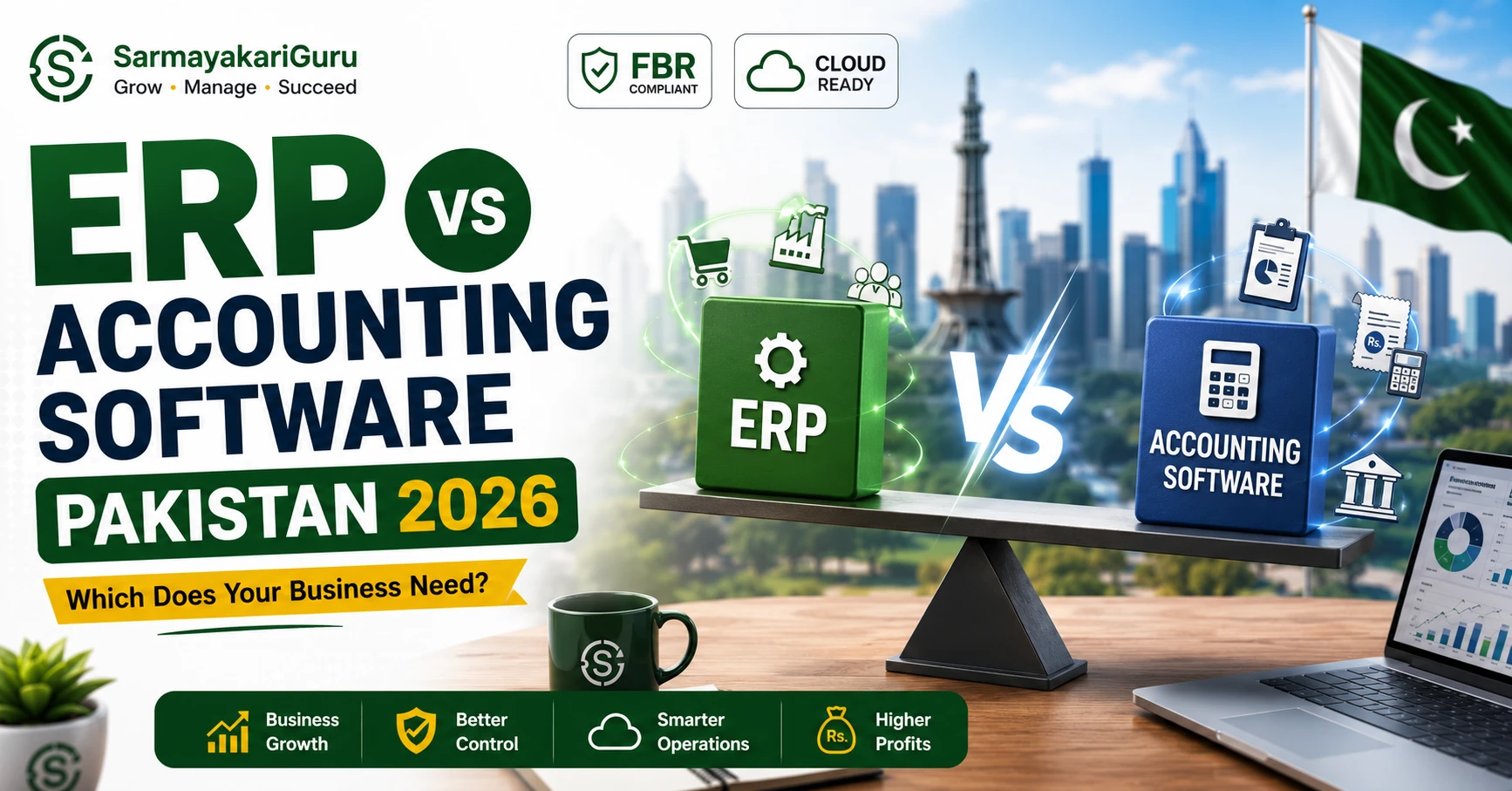

This is one of the most common questions Pakistani business owners ask — and honestly, the confusion is understandable. Both ERP and accounting software deal with your business finances. Both generate reports. Both cost money. So what is actually different, and which one does your business need right now?
Let us settle this properly.
The Simple Version First
Accounting software does one thing really well: it records your financial transactions and generates financial reports. Income, expenses, invoices, bank reconciliation — that is its world.
ERP software does all of that plus manages your entire business — inventory, HR, payroll, production, sales pipeline, purchasing, and accounting — all connected in one system.
Think of it this way. Accounting software is like hiring a skilled bookkeeper. ERP is like hiring a bookkeeper, a warehouse manager, an HR officer, and a sales coordinator — and having all four of them share the same notebook in real time.
What Accounting Software Covers in Pakistan
The most widely used accounting tools in Pakistan are QuickBooks, Peachtree, and basic Excel-based setups. Here is what they handle well:
Recording daily income and expenses, generating invoices, bank reconciliation, profit and loss statements, and balance sheets. For a freelancer, a small consultancy, or a sole proprietor with simple operations — this is often genuinely enough.
If you want to understand your FBR tax obligations as a small business using accounting software, the FBR IRIS portal is where you will file regardless of which software generates your numbers.
The limitation hits the moment your business has physical inventory, multiple staff members, or operations across more than one location. Accounting software cannot tell you how many units of a product are left in your warehouse. It cannot generate an EOBI-compliant payroll. It cannot track a purchase order from supplier to warehouse to accounts payable automatically. For that, you need ERP.
What ERP Covers That Accounting Software Cannot
A proper cloud ERP system manages your entire business operation, not just the financial records. Here is what that looks like in practice for a Pakistani business:
Inventory management — real-time stock levels across all your locations, automated reorder alerts, barcode scanning, and FIFO/LIFO valuation. When a sale is made on your POS, inventory automatically reduces. When a purchase order is received, stock automatically increases.
HR and payroll — attendance tracking, leave management, and monthly payroll processing with automatic EOBI contributions, PESSI deductions, and FBR salary tax withholding — all calculated correctly per Pakistan Labour Law without manual input.
Sales and purchasing — from lead capture to invoice to payment, and from purchase requisition to supplier order to goods receipt to accounts payable — the complete cycle managed in one system with no manual data re-entry between departments.
FBR compliance built in — every invoice generated is automatically FBR-compliant. Sales tax for all four provincial authorities — PRA, SRB, KPRA, and BRA — is calculated without you needing to know the applicable section. Your accounting and taxation services become significantly more straightforward when your ERP is already generating clean, compliant records. You can verify current FBR requirements at fbr.gov.pk.
The Pakistan-Specific Problem with Accounting-Only Software
Here is something that does not come up in international comparisons but matters enormously in Pakistan.
FBR’s compliance requirements are becoming more complex every year — e-invoicing requirements, withholding tax statements, provincial sales tax variations, and real-time data reporting are all moving targets. Accounting software that was adequate for FBR compliance in 2022 may not be adequate in 2026.
ERP systems built for Pakistan — like SarmayakariGuru ERP — update their FBR compliance modules automatically when regulations change. You wake up the morning after a new FBR SRO takes effect and your system already reflects the change. With standalone accounting software, you are often left waiting for a manual update or figuring out the changes yourself. Check atl.fbr.gov.pk to stay current on your filer status regardless of which software you use.
Side-by-Side Comparison
| Feature | Accounting Software | ERP Software |
|---|---|---|
| Financial recording | ✅ Yes | ✅ Yes |
| FBR invoice generation | ⚠️ Partial | ✅ Full |
| Inventory management | ❌ No | ✅ Yes |
| HR & payroll Pakistan | ❌ No | ✅ EOBI compliant |
| Purchase management | ❌ No | ✅ Yes |
| Multi-branch visibility | ❌ No | ✅ Yes |
| POS integration | ❌ No | ✅ Yes |
| Daraz/Shopify sync | ❌ No | ✅ Yes |
| Production planning | ❌ No | ✅ Yes |
| Price (Pakistan) | Rs. 8,000-25,000/yr | Rs. 15,000-25,000/month |
Which One Does Your Business Actually Need?
Choose accounting software if: You are a freelancer, a consultant, or a service business with fewer than five staff members, no physical inventory, and straightforward FBR compliance needs. QuickBooks or a local bookkeeping service will serve you well at this stage.
Choose ERP if: You have physical inventory to manage, more than five staff members on payroll, multiple locations or warehouses, a manufacturing or production process, or you sell on Daraz, Shopify, or multiple sales channels simultaneously. If any one of these describes your business, accounting software alone is already holding you back.
For retail businesses specifically, our retail ERP for Pakistani shops replaces your POS system, inventory spreadsheets, and accounting software in one package — at a total cost often lower than managing three separate systems.
For manufacturers, the manufacturing ERP handles BOM, production planning, raw material tracking, and FBR-compliant invoicing — things accounting software simply cannot touch.
For e-commerce sellers juggling Daraz, Shopify, and WhatsApp orders, our e-commerce ERP automatically syncs orders, updates inventory, and tracks COD payments from TCS and Leopards — saving hours of daily manual work.
The Cost Question — Is ERP Worth It Over Accounting Software?
This is where many Pakistani business owners hesitate. Accounting software costs Rs. 8,000 to Rs. 25,000 per year. ERP costs Rs. 15,000 to Rs. 25,000 per month. That gap feels significant.
But here is the calculation that changes the conversation.
A typical Pakistani business operating without ERP absorbs hidden costs every month — stock discrepancies, billing errors, payroll mistakes, manual data re-entry between departments, and time spent reconciling information across disconnected systems. For a business with 10 to 20 staff members, these inefficiencies conservatively cost Rs. 50,000 to Rs. 100,000 monthly in lost productivity and errors.
Against that baseline, a Rs. 20,000 monthly ERP subscription that eliminates most of those inefficiencies pays for itself within the first two to three months. Our SME ERP package is designed specifically to make this calculation work for Pakistani small businesses.
When to Upgrade from Accounting Software to ERP
There is no single magic number, but these are the signals that Pakistani business owners consistently describe as the tipping point:
You are spending more than two hours per day on manual data entry across disconnected systems. Your inventory count never quite matches your accounting records. You have opened a second location and managing two sets of spreadsheets is becoming unmanageable. Your payroll is taking your accountant three days every month to calculate. You are selling on Daraz and Shopify simultaneously and keeping inventory synced manually is a full-time job.
Any one of these signals means accounting software has become the bottleneck in your business — and the question is no longer whether to upgrade, but how quickly.
Book a free consultation with our ERP team and we will give you an honest assessment of whether your business is ready for ERP — and which modules you actually need versus which ones you can add later.