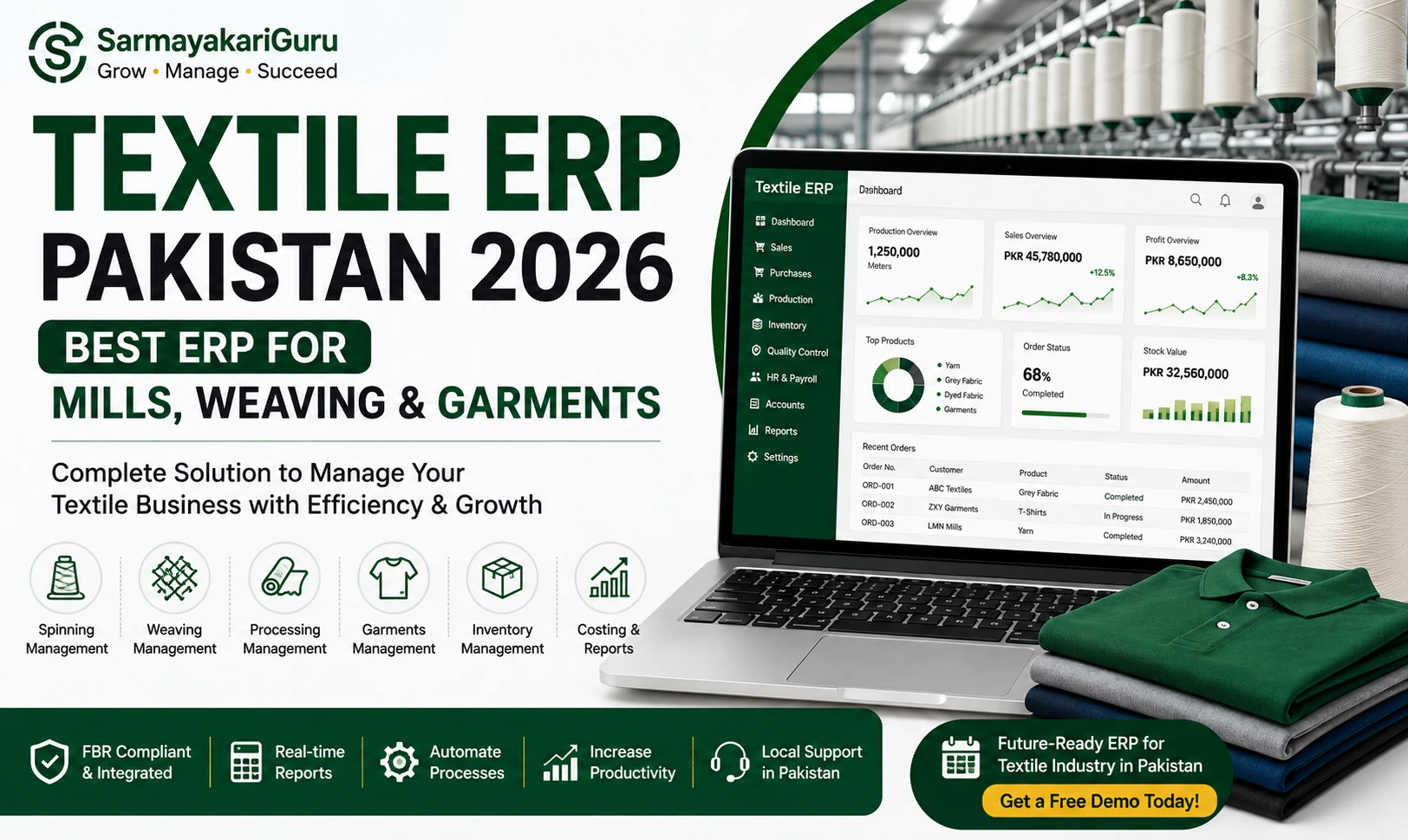

Pakistan’s textile sector is the backbone of the national economy — contributing over 60% of export earnings and employing millions of workers across Faisalabad, Lahore, Karachi, Sialkot, and beyond. Yet for all its scale and sophistication in production, most Pakistani textile businesses are still running their operations on disconnected Excel sheets, WhatsApp groups, and a visiting accountant who arrives at month end to make sense of the chaos.
If you run a spinning mill, a weaving unit, a dyeing and finishing plant, or a garment manufacturer in Pakistan — this is your honest guide to what textile ERP actually does, what it costs, and how to choose the right system for your specific operation.
Why Textile Businesses in Pakistan Need Specialized ERP
Not all ERP software works for textile. A generic retail ERP or a basic accounting system cannot handle the complexity of textile operations — and choosing the wrong system is one of the most expensive mistakes Pakistani mill owners make.
Textile production involves multi-stage processes where raw material transforms through spinning, weaving, dyeing, finishing, and cutting before becoming a finished product. At each stage, the material changes form, its value changes, and the cost structure changes. A textile ERP must track this transformation accurately — from grey fabric entering the dyeing department to finished processed fabric exiting to dispatch, with the correct cost posted to your accounting ledger at every stage.
Yarn inventory in a spinning mill is tracked by count, twist, lot number, and weight — not just quantity. Fabric in a weaving unit is measured in meters and kilograms simultaneously, with different specifications for warp and weft. Garment manufacturers track cut panels, stitching work orders, finishing operations, and packing — each a separate production stage with its own material consumption and labor cost. Generic ERP systems simply do not have these textile-specific data structures built in.
FBR compliance adds another layer of complexity. Pakistan’s textile sector has specific sales tax provisions — the zero-rating scheme for exporters, DTRE (Duty and Tax Remission for Exporters) accounts for import-based raw materials, and FBR’s e-invoicing requirements that have been progressively expanding to cover more textile businesses. A textile ERP built for Pakistan handles all of this as standard configuration, not as expensive customization work. You can check current FBR requirements for textile businesses at fbr.gov.pk.
What Textile ERP Pakistan Must Include
When evaluating any ERP system for your textile business in Pakistan, these are the non-negotiable modules.
Yarn and fiber inventory management covers raw material tracking from the moment cotton, polyester, or other fibers enter your premises. Lot-wise tracking, count-wise inventory, blend management for mixed fiber yarns, and automatic reorder calculation based on production schedules are all essential for spinning mills. Every yarn movement — from raw fiber to spinning to winding to dispatch — needs to be tracked with the correct unit of measure and cost.
Fabric production planning is the heart of any weaving unit’s ERP. Loom scheduling, beam preparation tracking, warp and weft consumption calculation, grey fabric production recording, and efficiency measurement per loom — these are the operational data points that determine whether a weaving unit is profitable. Without them in your ERP, your production planning stays in the supervisor’s head and your cost management stays on Excel.
Dyeing and processing batch management applies to dyeing units, processing mills, and vertically integrated textile operations. Recipe management for dye formulations, chemical consumption per batch, process parameters recording, and quality testing results against specifications — all connected to cost accounting so you know the actual processing cost per meter of finished fabric.
Garment order management covers the full cycle from buyer purchase order to shipment — cutting orders linked to fabric consumption, stitching work orders per style and size, trim and accessory tracking, finishing and packing, and export documentation generation. For Pakistani garment exporters, this connects directly to your LC documentation and FBR export records.
DTRE account management is specific to Pakistani textile exporters using the Duty and Tax Remission for Exporters scheme. Your ERP must track imported raw material quantities, process them through production, and match consumption against DTRE entitlements — generating the utilization statements FBR requires. Without this in your ERP, DTRE compliance becomes a manual exercise prone to errors and audit risk.
FBR e-invoicing with zero-rating handles the sales tax complexity for textile exporters — generating FBR-compliant e-invoices with the correct tax treatment for zero-rated export sales, local sales at standard rates, and inter-unit transfers within the same business.
Costing and profitability analysis ties everything together — calculating actual cost per unit of yarn, fabric, or garment by accumulating raw material, direct labor, processing chemicals, packing materials, and overhead allocation at each production stage. Compare actual production costs against standard costs to identify where your margins are being eroded.
For the complete list of modules available in SarmayakariGuru’s manufacturing ERP — which covers textile businesses specifically — see our manufacturing ERP Pakistan page.
Textile ERP for Different Operations in Pakistan
Pakistan’s textile sector spans multiple distinct operation types, each with different ERP requirements.
Spinning mills — predominantly in Faisalabad, Lahore, and Karachi — need fiber-to-yarn tracking with lot management, efficiency measurement per spindle, waste recording, and yarn inventory by count and twist. The spinning ERP must integrate with your weigh bridge for raw material receipt and your packing department for finished yarn dispatch.
Weaving units — concentrated in Faisalabad with significant presence in Lahore — require loom scheduling, beam preparation tracking, grey fabric production recording by loom number, and defect recording at the fabric inspection stage. Efficiency measurement — picks per minute, loom efficiency percentage — should be trackable from the ERP dashboard.
Dyeing and finishing plants need batch management with recipe control, chemical inventory tracked by lot and expiry, process parameter logging per batch, and quality test results against buyer specifications. For composite mills with both weaving and dyeing, the ERP must handle inter-department fabric transfer with proper cost allocation.
Garment manufacturers — particularly in Lahore, Karachi, and Sialkot — need the most complex ERP configuration. Style-wise production planning, cutting marker efficiency calculation, stitching work order management per line, quality rejection tracking by defect type, and packing documentation for export shipments all need to be in the system.
Fabric traders and exporters — operating across multiple textile cities — need inventory management for multiple fabric specifications, customer order tracking, LC documentation support, and FBR e-invoicing for both local and export sales.
For e-commerce textile businesses selling fabric or garments on Daraz or their own Shopify store, our e-commerce ERP handles order management across platforms while keeping inventory synchronized with your physical stock.
Textile ERP Pricing in Pakistan 2026
Textile ERP pricing in Pakistan varies significantly based on the scale and complexity of your operation.
For small to medium textile businesses — a single weaving unit with 50 to 100 looms, a small dyeing unit, or a garment factory with up to 200 machines — SarmayakariGuru’s manufacturing ERP starts from Rs. 150,000 one-time setup with Rs. 25,000 per month. This covers production planning, inventory management, FBR compliance, HR payroll for factory workers with EOBI calculations, and complete accounting integration.
For larger operations — spinning mills, composite textile units, or large garment manufacturers with multiple production lines — pricing is customized based on the number of users, production locations, and specific module requirements. Our team conducts a detailed operational assessment before providing a final quote to ensure you are not paying for modules your operation does not need.
The key point on pricing: for Pakistani textile businesses, the cost of not having proper ERP — in production inefficiencies, untracked waste, DTRE compliance errors, and FBR penalties — typically exceeds the ERP cost within the first year of operation.
You can explore our complete ERP pricing structure at our ERP solutions page or book a free consultation for a customized quote for your textile operation.
How to Choose Textile ERP in Pakistan — What to Ask
The Pakistani ERP market has several vendors claiming textile expertise. Here is how to verify the claims before committing.
Ask them to demonstrate yarn inventory management with lot tracking in a live demo — not describe it. If the vendor cannot show you count-wise yarn inventory with lot numbers and weight-based tracking in the demo system, the textile module is not genuinely built out.
Ask specifically about DTRE account management. This is a Pakistan-specific compliance requirement that most generic ERP systems — including international ones — have never heard of. A vendor who handles DTRE correctly understands Pakistani textile compliance deeply.
Ask about FBR e-invoicing support for textile businesses. Pakistan’s FBR has been progressively expanding mandatory e-invoicing to textile businesses — your ERP must generate invoices with IRN numbers and FBR QR codes that pass FBR’s real-time validation. Verify FBR’s current textile e-invoicing requirements at fbr.gov.pk.
Ask for references from textile businesses specifically — not generic manufacturing references. A spinning mill reference is more useful than a food processing factory reference.
Ask whether the system handles the unit of measure complexity that textile requires — meters, kilograms, and pieces simultaneously on the same inventory item. A system that can only track one unit of measure per product will create reconciliation problems immediately in a textile environment.
SarmayakariGuru Textile ERP — Built for Pakistan’s Mills
SarmayakariGuru’s manufacturing ERP covers the full range of textile operations in Pakistan — from fiber receipt at a spinning mill to export shipment from a garment factory. Our team has implemented ERP for textile businesses across Faisalabad, Lahore, Karachi, and Sialkot, and understands the operational and compliance complexity of Pakistan’s textile sector.
Our implementation team visits your facility — whether you are in Faisalabad’s textile city, Lahore’s industrial estates, or Karachi’s export processing zones — for the business assessment and initial setup. After go-live, your dedicated WhatsApp support line ensures production staff and management get quick answers when they need them.
For textile businesses that also need professional FBR tax filing, bookkeeping, and SECP compliance alongside their ERP, our accounting and taxation services handle the complete compliance cycle — your ERP data feeds directly into your tax filings without manual reconciliation.
For small textile businesses evaluating whether ERP is appropriate for their current size, our SME ERP solutions provide a structured entry point with the option to scale up modules as operations grow.